Product Description
ZheJiang CZPT Conveying Equipment Co.,Ltd
Product Description
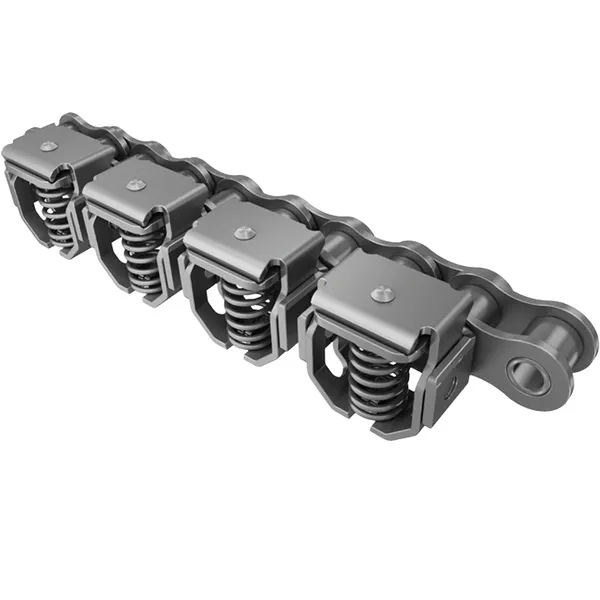
Bush roller chain(used in horizontal scraper conveyor)
1.Chains adopt high quality medium-carbon alloy steel, chain plate material is 40Mn, pin and roller material is 40Cr. High quality material and good heat treatment guarantee excellent anti-shearing force and tensile strength during working and have good looking.
2.Model: GLF For TGSS flat scraper conveyor, install flat scrapper
General & Dimension(Material: Carbon Steel, Stainless Steel)
| Type |
Pitch P mm |
between inner plates b1 mm |
Bush Diameter d mm |
Pin Diameter d1 mm |
Bush Diameter d2 mm |
Plate Width H mm |
Plate Thickness T mm |
Flight Attachment (mm) | Rated Strength KN |
|||
| Width L |
Distance L1 |
Distance L2 |
diameter D |
|||||||||
| GLF66.5(5-6)D
|
66.5
|
26.5
|
22.23
|
12.7
|
16.23
|
30
|
5/6
|
160 | 102 | / | 2-Φ9X14 | 140
|
| 230 | 95 | 195 | 4-Φ9X14 |
|||||||||
| 270 | 102 | 228 | ||||||||||
| GLF66.675(5-6)D
|
66.675
|
26.5
|
22.23
|
12.7
|
16.23
|
30
|
5/6
|
182 | 90 | 150 | 4-Φ9X14
|
140
|
| 215 | 95 | 195 | ||||||||||
| 295 | 95 | 195 | ||||||||||
| GLF100(6)
|
100
|
38.5
|
36.0
|
16.0
|
21.6
|
40
|
6
|
170 | 115 | 2-Φ9X14 | 180
|
|
| 225 | 95 | 195 | 4-Φ9X14
|
|||||||||
| 294 | 115 | 245 | ||||||||||
| 370 | 155 | 255 | ||||||||||
| GLF125(6)D |
125 |
32.5 |
25.0 |
18.0 |
20.00 |
50 |
6 |
300 | 115 | 245 | 4-Φ9X14 |
200 |
| 370 | 130 | 330 | ||||||||||
| GLF160(8)D×385 | 160 | 36.5 | 36.0 | 17.8 | 24.50 | 50 | 8 | 385 | 130 | 330 | 4-Φ11X15 | 220 |
| GLF200(8)D×467 | 200 | 42.5 | 40.0 | 20.0 | 30.00 | 60 | 8 | 467 | 160 | 420 | 4-Φ13X17 | 250 |
| 81X | 66.27
|
26.99
|
23.02
|
11.1
|
16.23
|
28.6 | 4 | Welding attached plate, length and hole size customized Wood transport chain according to customer requirements
|
107 | |||
| 81XH | 31.4 |
6/8 | 152 | |||||||||
| 81XHH | 8 | 191 | ||||||||||
NOTE: Other specifications which are not listed above can be made to customers’ specifications.
Bush roller chain(used in U type scraper conveyor)
Model: GLR For TGSU arc scraper conveyor, install U type scrapper
General & Dimension(Material: Carbon Steel, Stainless Steel)
| Type | Pitch P mm |
between inner plates b1 mm |
Bush Diameter D mm |
Pin Diameter d1 mm |
Bush Diameter d2 mm |
Plate Width H mm |
Plate Thickness T mm |
Flight Attachment (mm) | Rated Strength KN |
|||
| Width L mm |
Distance L1mm |
Distance L2mm |
diameter D mm |
|||||||||
| GLR68(5) | 68 | 25.3 | 22.23 | 11.1 | 16.23 | 29 | 5 | 102 | 32 | 4-Φ9 | 140 | |
| GLR60(6)D | 60 | 26.0 | 22.23 | 12.7 | 30 | 6 | 130 | 100 | 32 | 4-Φ9 | 140 | |
| GLR66.5(6)D | 66.5 | 26.5 | 22.23 | 12.7 | 16.23 | 30 | 6 | 130 | 102 | 32 | 4-Φ9 | 140 |
| GLR80(6)D | 80 | 32.0 | 28.00 | 18.0 | 42 | 6 | 160 | 120 | 32 | 4-Φ9 | 140 | |
| GLR100(6)D | 100 | 38.5 | 36.00 | 16.0 | 21.6 | 40 | 6 | 130 | 102 | 32 | 4-Φ9 | 180 |
Ring Chain
| DRAG CONVEYOR Type |
Ring Chain Type |
Pitch P(mm) |
Diameter d(mm) |
length L1(mm) |
Width W(mm) |
Flight Type |
Wing Width L(mm) |
Flight Width H(mm) |
| GSS16 | D10-55-13 | 55 | 10 | 74 | 32.5 | HF16 | 148 | 43.5 |
| GSS20 | D10-55-13 | 55 | 10 | 74 | 32.5 | HF20 | 188 | 43.5 |
| GSS25 | D10-55-13 | 55 | 10 | 74 | 32.5 | HF25 | 225 | 43.5 |
| GSS32 | D14-70-18 | 70 | 14 | 95 | 45 | HF32 | 300 | 54.5 |
| GSS40 | D14-70-18 | 70 | 14 | 95 | 45 | HF40 | 382 | 54.5 |
Offset Sidebar Chain
| Type | Pitch P mm |
Bush Diameter d1 |
Pin Diameter d |
Plate Width H |
Width between plates at inner ends b1 |
Width between plates at outer ends b2 |
Plate Thickness T1 |
Rated Strength KN |
Wing Plate Thickness T2 |
Wing Width L mm |
| WH78 | 66.27 | 22.23 | 12.7 | 28.4 | 28.4 | 51 | 6.4 | 93.4 | Welding attached plate, length and hole size customized | |
| WH82 | 78.1 | 27 | 14.29 | 32 | 44 | 57 | 6.4 | 132 | ||
| WH124 | 101.6 | 36.5 | 19.05 | 38.1 | 41.3 | 70 | 9.5 | 300 | ||
| WH132 | 153.67 | 44.45 | 25.25 | 50.8 | 77.1 | 111.76 | 12.7 | 378 | ||
| WH150 | 153.67 | 44.45 | 25.25 | 63.5 | 77.1 | 111.76 | 12.7 | 398 | ||
| WH155 | 153.67 | 44.45 | 28.42 | 63.5 | 73.6 | 111.25 | 14.27 | 411 | ||
| WH157 | 153.67 | 44.45 | 28.42 | 63.5 | 76.4 | 117.35 | 15.88 | 552 | ||
Forged Chain
| Pitch P(mm) |
Pin Diameter d(mm) |
Plate Width H(mm) |
b1 (mm) |
b2 (mm) |
b3 (mm) |
T1 (mm) |
T2 (mm) |
Wing Width L(mm) |
Rated Strength |
| 100 | 14 | 30 | 15 | 33 | 16 | 13 | 6(8) | Welding attached plate, length and hole size customized | 140KN |
| 125 | 17 | 35 | 17 | 34 | 18 | 8 | 6(8) | 150KN | |
| 142 | 25.4 | 50.8 | 19 | 43 | 20 | 12.2 | 8(10) | 270KN | |
| 142(H) | 25.4 | 50.8 | 29 | 62 | 30 | 15 | 8(10) | 340KN | |
| 150 | 18 | 40 | 18 | 40 | 20 | 11.5 | 6(8.10) | 200KN | |
| 200 | 21 | 45 | 20 | 42 | 22 | 12.2 | 6(8.10) | 270KN |
Company Profile
ZheJiang CZPT CONVEYING EQUIPMENT CO. LTD., Established in 2011, specializing in bucket elevator, conveyor parts manufacturing, in recent years, more than 10 research and development of food conveying accessories obtained national invention and edible new patents.
Our factory is located in Daoshu Industrial Park, HangZhou City, ZheJiang Province, which is 1 of the most developed industrial areas in China. The company covers 28,000 square CZPT with the floor area of 8,000 square meters.
Our main products include elevator bucket, drag conveyor flight, UHMW-PE sheet, PVC elevator belts, elevator bolts, belt fastener, conveyor chains and more than 4 hundred types components which are widely used in bulk material handling and storage industry.
JINGWEI currently has more than 10 units of the whole series of 250-2500g injection molding machines, 1 production line of UHMW-PE sheet which is the higher pressure per unit in China, 1 special production line for PVC CZPT woven belt, 1 production line of elevator bolts and nut, 1 production line for conveyor chains. We annually produce 5 million plastic elevator buckets, 2 million steel buckets, 500 tons of UHMW-PE products, 0.8 million square CZPT of PVC CZPT woven elevator belt, 15 billion sets of elevator bolts, and 60,000 CZPT of conveyor chains.
Our company strictly in accordance with ISO9001 Quality Management System, and has obtained SGS certification. In order to raising working efficiency and reducing the cost of production, our company makes full use of computer network and ERP system to reform integration management in enterprise resource management, on the base of that, we have the ability to provide high quality products with competitive price and best service to customers.
JINGWEI believes the enterprise spirit of “integrity, pragmatic and innovative.” We will strive to become 1 of the best one-stop suppliers in the industry.
| Material: | Steel/Satinless Steel |
|---|---|
| Structure: | Conveyor Chain |
| Surface Treatment: | Shot Peening |
| Chain Size: | Glf/Glr |
| Feature: | Fire Resistant, Oil Resistant, Heat Resistant |
| Function: | transmission |
| Samples: |
US$ 20/Piece
1 Piece(Min.Order) | |
|---|
| Customization: |
Available
| Customized Request |
|---|

What are the considerations for selecting a corrosion-resistant conveyor chain?
When selecting a corrosion-resistant conveyor chain, several factors need to be considered to ensure the chain’s longevity and performance in corrosive environments. Here are some key considerations:
1. Material Selection: Choose a chain material that is inherently resistant to corrosion. Stainless steel, such as AISI 304 or AISI 316, is a common choice due to its excellent corrosion resistance properties. Other materials like plastic chains or special alloys can also be considered based on the specific application requirements.
2. Coatings and Surface Treatments: In some cases, additional protective coatings or surface treatments can be applied to enhance the chain’s corrosion resistance. These coatings, such as zinc plating, galvanizing, or epoxy coatings, create a barrier between the chain material and corrosive substances, preventing direct contact and reducing the risk of corrosion.
3. Environmental Compatibility: Consider the specific corrosive agents present in the environment where the conveyor chain will be used. Different corrosive substances, such as acids, alkalis, or saltwater, require specific resistance properties. Ensure that the selected chain material and coatings are compatible with the corrosive agents present in the operating environment.
4. Maintenance and Lubrication: Proper maintenance and lubrication play a crucial role in preventing corrosion and extending the life of a conveyor chain. Regular cleaning, inspection, and application of appropriate lubricants can help remove corrosive contaminants and protect the chain surface from degradation.
5. Testing and Certification: Consider chains that have undergone testing and certification for corrosion resistance in relevant industry standards. Look for certifications such as ISO 9227 (salt spray test) or ASTM B117 (corrosion resistance test) to ensure the chain’s performance in corrosive environments.
By carefully considering these factors and consulting with conveyor chain manufacturers or corrosion-resistant experts, you can select a chain that is well-suited for your specific corrosive environment, minimizing the risk of corrosion-related issues and ensuring optimal performance and longevity.
What are the best practices for storing and handling conveyor chains?
Proper storage and handling of conveyor chains are essential to maintain their performance, prevent damage, and prolong their lifespan. Here are some best practices to consider:
1. Clean and dry storage area: Store conveyor chains in a clean and dry environment to prevent the accumulation of dirt, dust, moisture, or contaminants that can affect their performance and cause corrosion.
2. Adequate support: Ensure that the stored conveyor chains are properly supported to prevent excessive bending or deformation. Use pallets, racks, or designated storage containers that can accommodate the weight and length of the chains.
3. Avoid excessive heat or cold: Conveyor chains should be stored in an area with a moderate temperature range to avoid extreme heat or cold that can affect the material properties or lubrication of the chains.
4. Protection against impacts and vibrations: Protect the stored chains from impacts or excessive vibrations that can cause damage or deformation. Use suitable packaging or covers to shield the chains from any potential physical damage.
5. Lubrication: Apply a thin layer of appropriate lubricant to the chains before storage to prevent corrosion and maintain their smooth operation. Follow the manufacturer’s recommendations for lubrication type and quantity.
6. Regular inspections: Periodically inspect the stored conveyor chains to ensure there are no signs of damage, corrosion, or deformation. If any issues are identified, take appropriate actions such as cleaning, lubricating, or replacing the chains.
7. Proper handling techniques: When handling conveyor chains, use appropriate lifting equipment or tools to avoid excessive strain or bending. Avoid dragging or dropping the chains, as this can cause damage to the chain links or attachments.
8. Training and awareness: Provide training to personnel involved in handling and storing conveyor chains to ensure they understand the proper procedures and best practices. Promote awareness of the importance of careful handling and storage to prevent accidents and maintain chain integrity.
By following these best practices, you can ensure the longevity and reliable performance of your conveyor chains, reducing the risk of downtime and costly repairs.

What are the advantages of using a conveyor chain in material handling?
Conveyor chains offer numerous advantages in material handling applications, making them a preferred choice in various industries. Here are some of the key advantages:
- Efficient Transportation: Conveyor chains provide a continuous and reliable means of transporting materials, ensuring a smooth flow throughout the production or distribution process. They can handle both light and heavy loads, enabling efficient movement of items of different sizes and weights.
- Increased Productivity: By automating the material handling process, conveyor chains help increase productivity and operational efficiency. They eliminate the need for manual handling and reduce human effort, allowing employees to focus on other tasks, resulting in higher throughput and reduced labor costs.
- Flexibility and Customization: Conveyor chains can be designed and configured to meet specific material handling requirements. They are available in various lengths, widths, and configurations, allowing for customization based on the layout and space constraints of the facility. Additionally, different types of conveyor chains can be selected to handle specific materials or accommodate special handling needs.
- Improved Safety: Conveyor chains enhance workplace safety by reducing the risk of manual lifting and carrying heavy loads. They provide a controlled and controlled movement of materials, minimizing the chances of accidents and injuries. Additionally, safety features such as emergency stop buttons, guardrails, and sensors can be incorporated into the conveyor system to further enhance safety.
- Space Optimization: Conveyor chains utilize vertical and horizontal space efficiently, making them ideal for facilities with limited floor space. They can be designed to navigate corners, inclines, and declines, allowing for optimized layout and maximizing the use of available space.
- Versatility: Conveyor chains are versatile and can handle a wide range of materials, including bulk items, packaged goods, fragile items, and irregularly shaped objects. They can accommodate different types of conveyance methods such as flat, inclined, or spiral conveyors, providing flexibility in material handling processes.
- Improved Inventory Control: Conveyor chains enable better inventory control by facilitating the smooth movement and tracking of materials. They can be integrated with barcode scanners, RFID technology, or other tracking systems to monitor the flow of goods and provide real-time information on inventory levels.
- Reduced Material Damage: Conveyor chains help minimize material damage during handling and transportation. They provide a stable and controlled movement, reducing the risk of items falling or getting damaged due to manual handling or rough transportation methods.
The advantages of using a conveyor chain in material handling include improved efficiency, productivity, safety, space utilization, and inventory control, leading to cost savings and enhanced overall operational performance.


editor by CX 2023-07-25