Product Description
Product Description
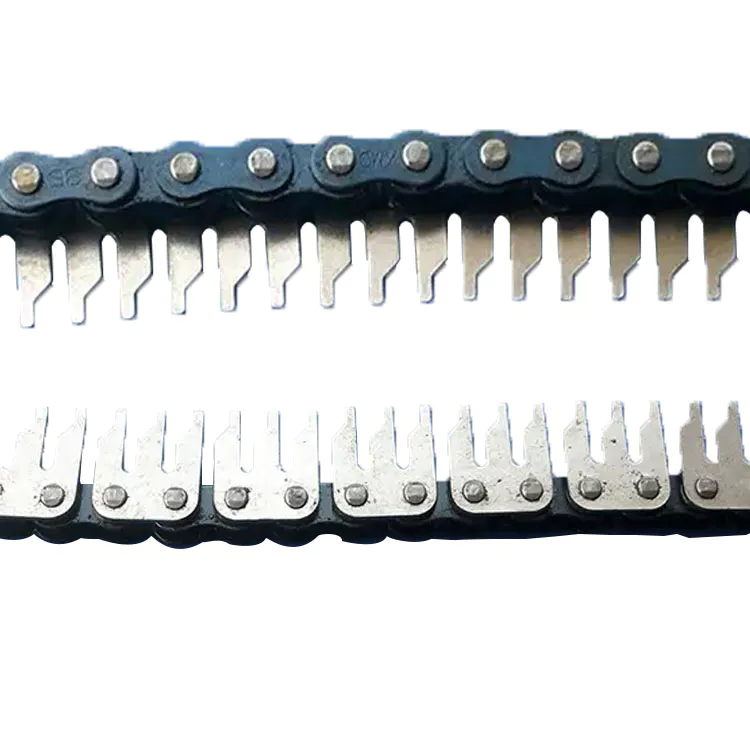
Hollow pin chain, cast fixed pin chain, pintle chain, drop forged link chain and Engineer Class Driving Chain, with alloy steel and stainless steel selection according to your requirement
1, Chain types: drop forged rivetless chain, Roller Chain, conveyor chain, agricultural chain, sugar industry chain, palm oil industry chain, asphalt industry chain,elevator conveyor industry chain, double flex chain, pintle chain, weld steel drag chains, malleable chain etc;
2, Main materials: It is 40Mn. 40Cr, 45Mn alloy steel or SUS304 for plates, 10#, 20#, 20CrMnMo, 30CrMnTi for pins and rollers;
3, Heat treatment: Carburizing, Austemper Stressing, nitro-caburizing harden etc;
4, Surface: Shot peening, black, blue or original;
5, Package way: Plastic bag+ carton box+ plywood case
Detailed Photos
| ISO | ANSI | ||||||||||||
| Pitch | Roller diameter | Roller diameter | Width between inner plates | Pin diameter | Chain path depth | Plate depth | Maximum width over bearing pin | Connecting pin length | Minimum cranked link dimensions | Ultimate tensile strength | Weight per meter | ||
| p | d1(max) | d7(max) | b1(min) | d2(max) | h1(min) | h2(max) | b4 (max) | bs(max) | L1(min) | Q(min) | q≈ | ||
| mm | mm | mm | mm | mm | mm | mm | mm | mm | kN | kg/m | |||
| 208A | A2040 | 25.4 | 7.95 | 15.88 | 7.85 | 3.98 | 12.33 | 12.07 | 17.8 | 21.7 | 6.9 | 13.8 | 0.42 |
| 208B | 8.51 | 7.75 | 4.45 | 12.07 | 11.81 | 17 | 20.9 | 17.8 | 0.45 | ||||
| 210A | A2050 | 31.75 | 10.16 | 19.05 | 9.4 | 5.09 | 15.35 | 15.09 | 21.8 | 25.9 | 8.4 | 21.8 | 0.73 |
| 210B | 10.16 | 9.65 | 5.08 | 14.99 | 14.73 | 19.6 | 23.7 | 22.2 | 0.63 | ||||
| 212A | A2060 | 38.1 | 11.91 | 22.23 | 12.57 | 5.96 | 18.34 | 18.1 | 26.9 | 31.5 | 9.9 | 31.3 | 1.02 |
| 212B | 12.07 | 11.68 | 5.72 | 16.39 | 16.13 | 22.7 | 27.3 | 28.9 | 0.76 | ||||
| 216A | A2080 | 50.8 | 15.88 | 28.58 | 15.75 | 7.94 | 24.39 | 24.13 | 33.5 | 38.9 | 13 | 55.6 | 1.7 |
| 216B | 15.88 | 17.02 | 8.28 | 21.34 | 21.08 | 36.1 | 41.5 | 60 | 1.75 | ||||
| 220A | A2100 | 63.5 | 19.05 | 39.67 | 18.9 | 9.54 | 30.48 | 30.17 | 41.1 | 47.2 | 16 | 87 | 2.55 |
| 220B | 19.05 | 19.56 | 10.19 | 26.68 | 26.42 | 43.2 | 49.3 | 95 | 2.62 | ||||
| 224A | A2120 | 76.2 | 22.23 | 44.45 | 25.22 | 11.11 | 36.55 | 36.2 | 50.8 | 57.4 | 19.1 | 125 | 4.06 |
| 224B | 25.4 | 25.4 | 14.63 | 33.73 | 33.4 | 53.4 | 60 | 160 | 4.7 | ||||
| 228B | 88.9 | 27.94 | 30.99 | 15.9 | 37.46 | 37.08 | 65.1 | 72.5 | 21.3 | 200 | |||
| 232B | 101.6 | 29.21 | 30.99 | 17.81 | 42.72 | 42.29 | 67.4 | 75.3 | 24.4 | 250 | |||
| C208B | 25.4 | 8.51 | 15.88 | 7.75 | 4.45 | 12.07 | 11.81 | 17 | 20.9 | 6.9 | 17.8 | 0.55 | |
| C208BL | 4.45 | 0.89 | |||||||||||
| C208A | C2040 | 7.92 | 7.85 | 3.98 | 12.33 | 12.07 | 17.8 | 21.7 | 6.9 | 13.9 | 0.5 | ||
| C208AL | C2042 | 0.84 | |||||||||||
| C210A | C2050 | 31.75 | 10.16 | 19.05 | 9.4 | 5.09 | 15.35 | 15.09 | 21.8 | 25.9 | 8.4 | 21.8 | 0.78 |
| C210B | 5.08 | 14.99 | 14.73 | 22.2 | 0.78 | ||||||||
| C210AL | C2052 | 5.08 | 15.35 | 15.09 | 21.8 | 1.27 | |||||||
| C212A | C2060 | 38.1 | 11.91 | 22.23 | 12.57 | 5.96 | 18.34 | 18.1 | 26.9 | 31.5 | 9.9 | 31.3 | 1.12 |
| C212AH | C2062H | 1.44 | |||||||||||
| C212B | 38.1 | 12.07 | 22.23 | 11.68 | 5.72 | 16.39 | 16.13 | 22.7 | 9.9 | 28.9 | |||
| C216A | C2080 | 50.8 | 15.88 | 28.58 | 15.75 | 7.94 | 24.39 | 24.13 | 33.5 | 38.9 | 13 | 55.6 | 2.08 |
| C216AH | C2080H | 2.54 | |||||||||||
| C216B | 17.02 | 8.28 | 21.34 | 21.08 | 36.1 | 13 | 60 | ||||||
| C220A | C2100 | 63.5 | 19.05 | 19.05 | 18.9 | 9.54 | 30.48 | 30.17 | 41.1 | 47.2 | 16 | 87 | 3.01 |
| C220AH | C2102 | 39.67 | 3.6 | ||||||||||
| C220B | 63.5 | 39.67 | 19.56 | 10.19 | 26.68 | 26.42 | 43.2 | 16 | 95 | ||||
| C224A | C2120 | 76.2 | 22.23 | 44.45 | 25.22 | 11.11 | 36.55 | 36.2 | 50.8 | 57.4 | 19.1 | 125 | 4.66 |
| C224AH | C2122 | 5.26 | |||||||||||
| C224B | 25.4 | 25.4 | 14.63 | 33.73 | 33.4 | 53.4 | 19.1 | 160 | |||||
| C232AH | 101.6 | 28.58 | 57.15 | 31.55 | 14.29 | 48.74 | 48.26 | 69.4 | 25.2 | 222.4 | 9.06 | ||
Product Parameters
Packaging & Shipping
1. Inner packing: Poly bag, air bubble bag, carton according to buyer’s request.
2. Outer packing: OSB case or pallet.
3. Please remember to leave the correct contact ADDRESS information for delivery.
Our Advantages
Company Profile
We are a leading manufacturer of mechanical transmission spare parts, as well as several years 1 of reliable and trustworthy vendors. Our main items are roller chain, conveyor chain, agricultural chain, sugar industry chain, palm oil industry chain, asphalt industry chain,elevator conveyor industry chain etc.
At present, For South American, European, and Asian market, our superior products are fabricated according to your requirement and our quality meets ISO, ASME, DIN standard.
Please watch our process steps as below
(1) punch its outer plate and inner plates
(2)Shot peening workshop
(3) heat treatment workshop
(4) assembly preparation
(5) pins process
(6) Tensile Properties Test before shipment
After Sales Service
Our products can be repaired or replaced the new parts with free cost in six months.
FAQ
Question:
1.Q:How about mould cost?
A: primarily depend on : 1.Drawing, 2.material, 3.weight and quantity.
We need to know the structure of each parts to analyze the mold solution by:
1) –Complete design drawing, product model or actual sample —– the best way
–PDF drawing with complete dimension for each parts
–Clearly photos for each parts with more angle-views to show every features.
2)The materials, technical parameters and surface treatments.
technical parameters: tell us about its model, pitch, roller diameter, width between inner plates, attachment type, outside drawing etc.
3)The quantity of order.
2.Q:How to control the product processing?
A: The processing report or pictures will be sent to the customer every week/ each month for review.
3.Q:Who will own the mould?
A:Customer, also the mould can be kept in our factory for future order.
4.Q:How long do you make your quotation?
A:After receiving detail informations we will quote in 1 to 3 days.
5.Q: MOQ? —
small chain type: if its pitch is less than 38.10mm and its thickness is less than 5mm, MOQ is 1500 CHINAMFG on these roller chains or conveyor chains;
middle chain type: if its pitch belongs (38.10mm
big chain type: if its pitch is more than 76.20mm and its thickness is more than 10mm, MOQ is 200 CHINAMFG on these roller chains or conveyor chains;
I hope we can do business together, and look CHINAMFG to hearing from you soon
/* March 10, 2571 17:59:20 */!function(){function s(e,r){var a,o={};try{e&&e.split(“,”).forEach(function(e,t){e&&(a=e.match(/(.*?):(.*)$/))&&1
| Material: | Alloy Steel |
|---|---|
| Structure: | Roller Chain |
| Surface Treatment: | Shot Peening |
| Chain Size: | 8inch |
| Feature: | Heat Resistant |
| Transport Package: | Plywood Case |
| Samples: |
US$ 65/Meter
1 Meter(Min.Order) | |
|---|
| Customization: |
Available
| Customized Request |
|---|
Can a conveyor chain be used in automotive assembly lines?
Yes, a conveyor chain can be effectively used in automotive assembly lines. Here are the reasons why:
1. Efficient Material Handling:
– Conveyor chains provide a reliable and efficient means of transporting automotive components and parts along the assembly line. They can handle heavy loads and withstand the demanding requirements of automotive manufacturing.
2. Versatility:
– Conveyor chains offer versatility in terms of design and configuration. They can be customized to accommodate various assembly processes, such as body welding, painting, assembly, and final inspection.
3. Precise Positioning:
– Conveyor chains allow precise positioning and synchronization of automotive components, ensuring accurate assembly and alignment during the production process. This helps maintain consistent quality and reduces errors.
4. Automation Integration:
– Conveyor chains can be easily integrated with automation systems in automotive assembly lines. They can work in conjunction with robotic arms, vision systems, and other automated equipment to optimize the production process and improve efficiency.
5. Assembly Line Flexibility:
– Conveyor chains provide flexibility in terms of line configuration and layout. They can be designed to accommodate different assembly line layouts, including straight sections, curves, inclines, and declines, to meet the specific requirements of automotive assembly processes.
6. Space Optimization:
– Conveyor chains help optimize space utilization in automotive assembly plants. They can be designed to navigate around existing equipment and infrastructure, making efficient use of available floor space.
7. Safety:
– Conveyor chains are designed with safety features to protect operators and prevent accidents. Emergency stop controls, guarding, and interlocking mechanisms ensure the safe operation of the assembly line.
8. Increased Production Speed:
– By using conveyor chains, automotive assembly lines can achieve higher production speeds, allowing for faster manufacturing cycles and increased output.
Overall, conveyor chains play a crucial role in enhancing the efficiency, productivity, and safety of automotive assembly lines, contributing to the smooth and streamlined production of vehicles.
What are the advantages of using a plastic conveyor chain?
Plastic conveyor chains offer several advantages over traditional metal chains. Here are some of the key advantages:
1. Corrosion Resistance: Plastic chains are highly resistant to corrosion, making them ideal for applications in humid or corrosive environments. They do not rust or deteriorate when exposed to moisture or chemicals.
2. Lightweight: Plastic chains are significantly lighter than metal chains, making them easier to handle and install. Their lightweight nature reduces the overall weight of the conveyor system and can result in energy savings during operation.
3. Low Noise Operation: Plastic chains generate less noise compared to metal chains, leading to a quieter working environment. This can be particularly beneficial in industries where noise reduction is important, such as food processing or packaging.
4. Reduced Friction and Wear: Plastic chains have self-lubricating properties, which reduce friction and wear. This results in lower maintenance requirements and longer chain life. The smooth surface of plastic chains also minimizes the risk of product damage during transportation.
5. Flexibility and Modularity: Plastic chains can be easily customized and designed to fit specific conveyor system requirements. They offer flexibility in terms of length, width, and configuration. Additionally, plastic chains are often modular, allowing for easy replacement of damaged or worn-out sections without replacing the entire chain.
6. Cost-Effective: Plastic conveyor chains are generally more cost-effective compared to metal chains. They are often less expensive to manufacture and offer a longer lifespan with minimal maintenance requirements, resulting in lower overall costs.
7. Chemical Resistance: Plastic chains are resistant to a wide range of chemicals, making them suitable for applications where exposure to aggressive substances is a concern. They can withstand contact with oils, acids, alkalis, and various cleaning agents.
Overall, the advantages of using a plastic conveyor chain include corrosion resistance, lightweight design, low noise operation, reduced friction and wear, flexibility, cost-effectiveness, and chemical resistance. These benefits make plastic chains a popular choice in various industries, including food processing, packaging, pharmaceuticals, and logistics.
What is a conveyor chain and how does it work?
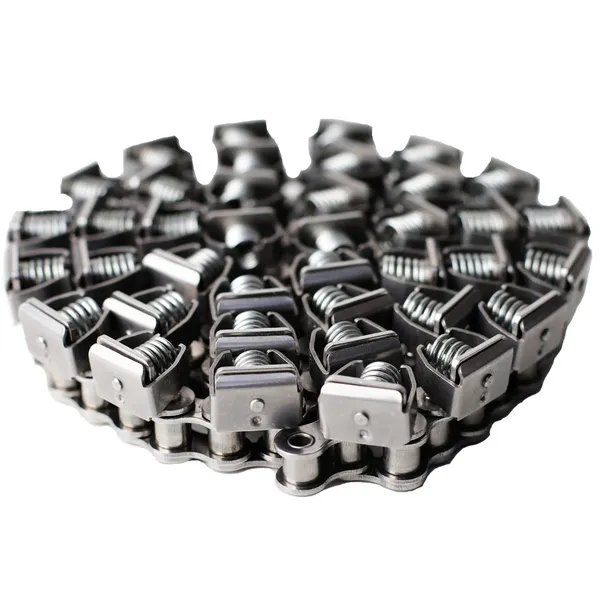
A conveyor chain is a type of mechanical chain specifically designed for use in conveyor systems. It is composed of a series of interconnected links that form a continuous chain loop. The links are typically made of metal and are joined together through pins or other connecting elements.
Conveyor chains work by transferring power and motion from the driving mechanism, such as a motor or sprocket, to the conveyor system to move materials or products along a predetermined path. The chain is placed on a track or guide rails, and as it moves, it carries the load placed on it.
The operation of a conveyor chain involves the following steps:
- Power transmission:
The driving mechanism transfers rotational power to the conveyor chain, typically through a motor and sprockets. The motor provides the necessary torque to drive the chain.
- Traction and motion:
As the driving mechanism rotates the sprockets, the teeth of the sprockets engage with the links of the conveyor chain. This interaction creates traction, causing the chain to move along the desired path.
- Load carrying:
The load to be transported is placed on the conveyor chain. The load can be in the form of products, materials, or other items. As the chain moves, it carries the load along the conveyor system, allowing for efficient transportation or handling.
- Support and guidance:
The conveyor chain is supported and guided by various components, such as guide rails, rollers, or wear strips. These components ensure the proper alignment and smooth movement of the chain along the conveyor system.
Conveyor chains are commonly used in industries such as manufacturing, logistics, packaging, and material handling. They offer a reliable and efficient method for moving products or materials in a controlled and automated manner.


editor by CX 2024-02-08