
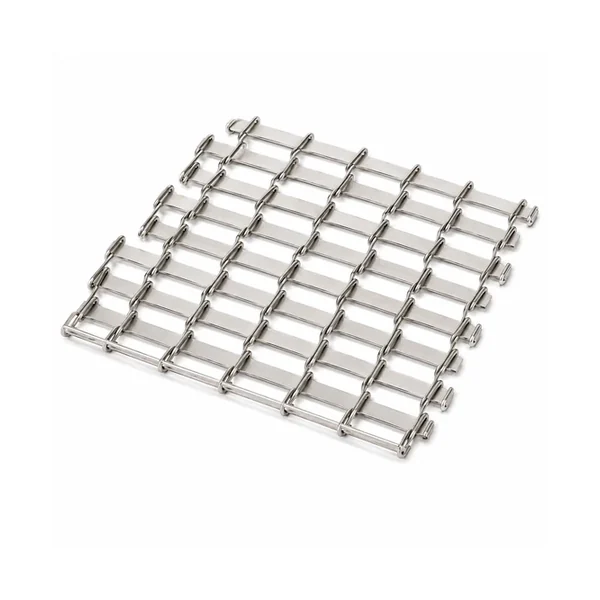
Flat Wire Conveyor Belt
Flat wire conveyor belt family with FW/CFW designation examples, listed nominal weights and open-area structures for processing, transfer and packaging equipment.
Flat Wire Conveyor Belt
Flat wire belts use formed flat-wire sections joined by cross rods, creating an open carrying surface with relatively broad contact bands. The series specification identifies flat-wire pitch, rod pitch, rod diameter and flat-wire size as the core designation variables and lists FW and CFW examples. For replacement procurement, keep the complete designation string including the suffix because two belts that share the same first pitch value can differ in rod or flat-wire geometry. The published nominal weight is useful as a cross-check, not a substitute for physical measurement.
For replacement work, treat the belt mesh, cross rods, edges, supports and drive as one interface. The part should be compared with the conveyor that exists today, including any guide, carrier or sprocket modifications made after the original machine was commissioned.
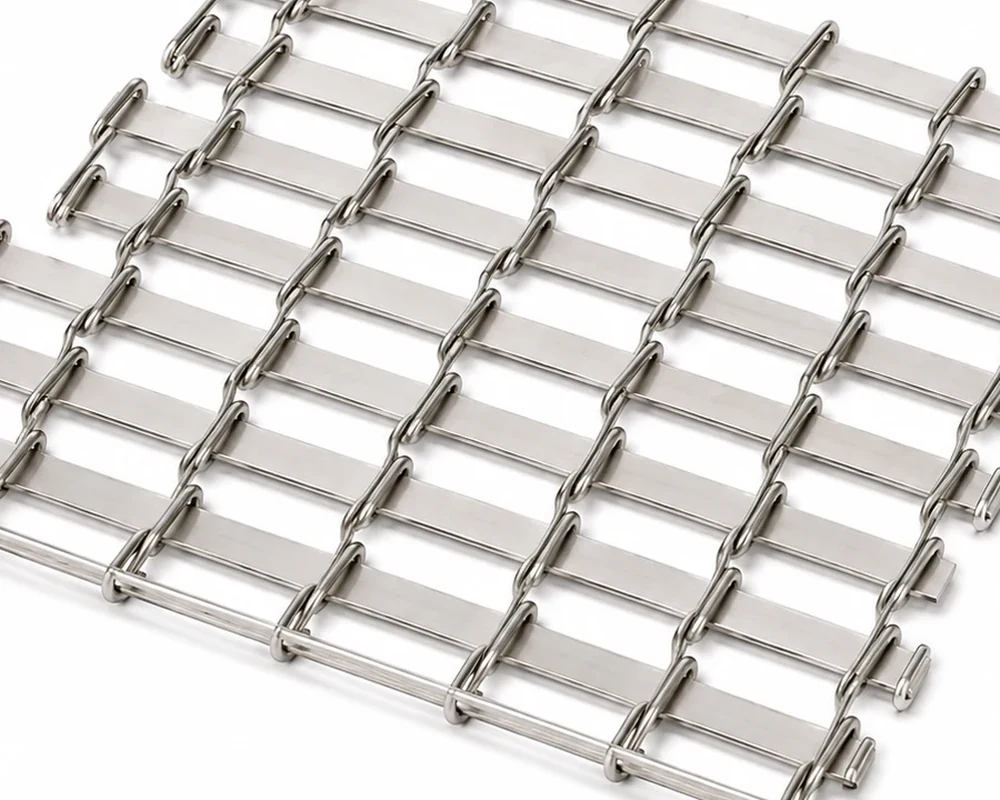
Check the features that control fit and motion
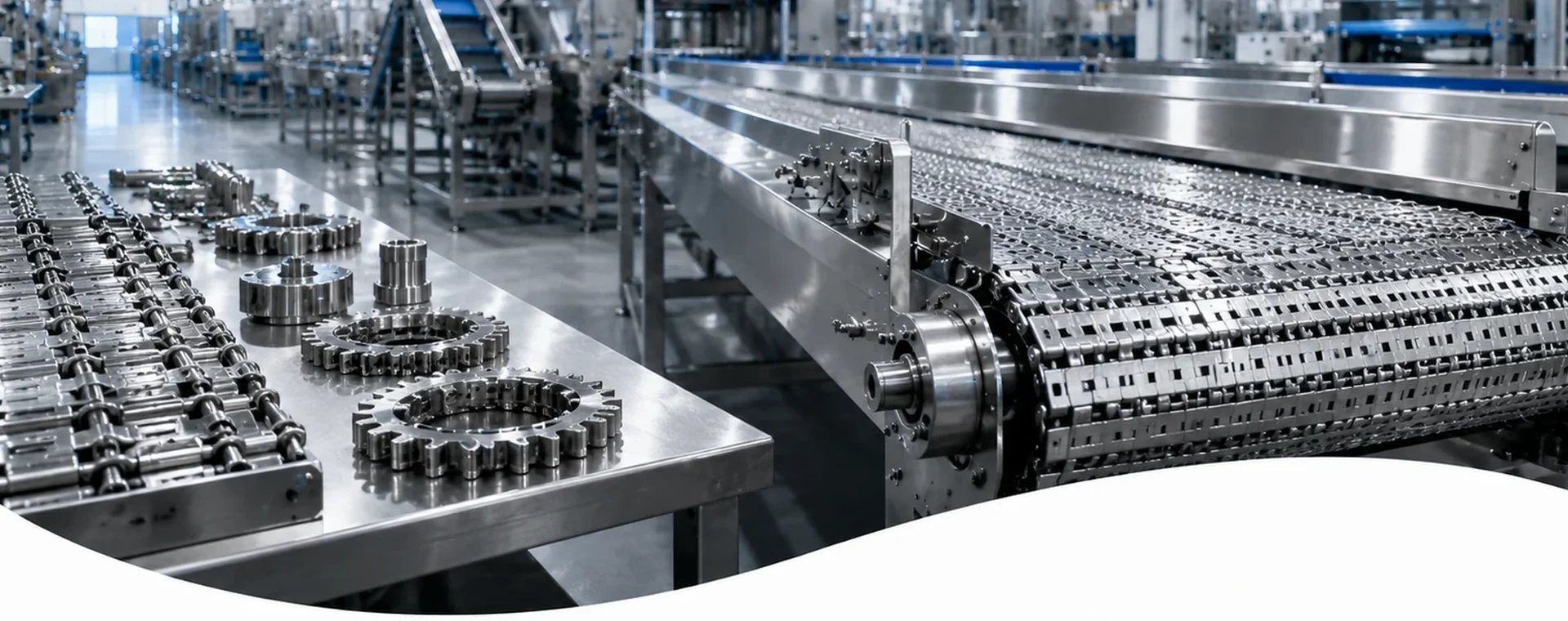
The key review points are product support, tracking, transfers and drive engagement. Measure several repeating features where possible instead of relying on one worn joint, rod or attachment. Photograph the component while it is still installed so running direction, guide contact and drive engagement are visible.
Selection should balance product support, airflow or drainage, drive engagement and allowable open area. Small product pieces may require tighter spacing, while cooling or washing duties may favor more open construction. Measure the actual belt width, edge arrangement and cross-rod retention method in addition to the designation. If the existing belt uses flights, side guards or special transfer edges, include them on a sketch. A photo that shows only the top surface is insufficient for a precise replacement because edge and rod details often define the assembly method.
When dimensions are uncertain, label them as measured from a worn sample rather than rounding them into an assumed nominal value. This makes it easier to distinguish a true dimensional conflict from normal service wear during technical review.
Technical drawing and specification
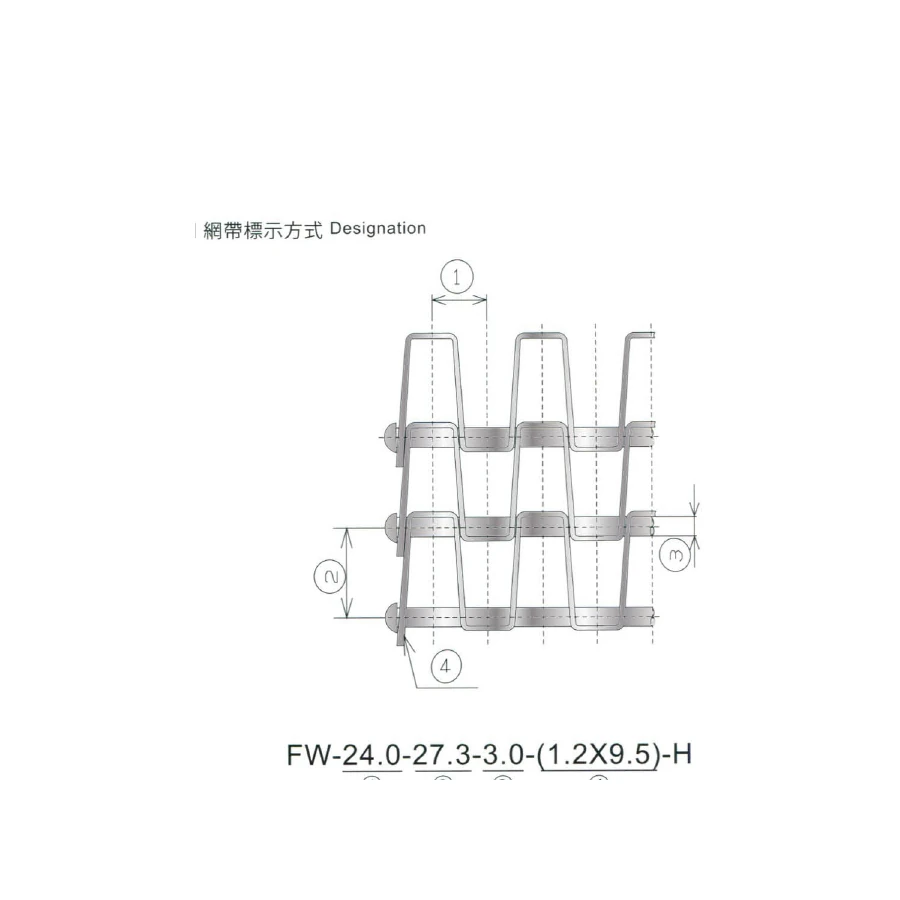
Dimension key: Flat wire designation: 1 = flat wire pitch; 2 = rod pitch; 3 = rod diameter; 4 = flat wire size. Suffixes such as H, C and PH are retained as series specification designations.
| Designation | Weight (kg/m²) |
|---|---|
| FW-24.0-27.3-3.0-(1.2×9.5)-H | 17.59 |
| FW-18.0-27.4-5.0-(1.5×12.7)-H | 22.61 |
| FW-12.7-25.4-3.0-(1.42×9.4)-H | 23.89 |
| FW-25.4-25.4-3.0-(1.42×9.4)-H | 16.96 |
| FW-26.25-31.75-5.0-(2×15)-H | 24.17 |
| FW-32-50-5.0-(1.5×12.7)-H | 12.16 |
| FW-24.0-27.3-3.0-(1.2×9.5)-C | 9.06 |
| FW-16.0-27.4-3.0-(1.2×9.5)-H | 11.03 |
| FW-12.7-12.7-3.0-(1.42×9.4)-PH | 24.28 |
| FW-24.0-27.3-5.0-(1.5×12.7)-H | 16.01 |
| CFW-24.0-27.3-5.0-(1.5×12.7)-H | 16.01 |
| CFW-18.0-27.4-5.0-(1.5×12.7)-H | 16.95 |
The table reproduces the available model/configuration data for this product page. Values not listed here should be confirmed from the project drawing, current component or machine interface rather than inferred from another series.

Evaluate the component inside the complete conveyor path
Flat Wire Conveyor Belt is considered for food-processing, cooling, washing and transfer equipment. In addition to the component dimensions, state the product being conveyed, spacing, line speed, starts and stops, curve or incline conditions, process zones and sanitation method. These operating inputs help identify the interfaces that deserve extra attention during approval.
Inspect the drive, supports, transfer points and return path for wear or modification. If damage repeats at one machine position, correct that interface before judging a new chain or belt. A replacement component cannot compensate for a burr, misaligned guide, damaged sprocket or unsupported transfer.
Commission at low speed before normal production
Install the belt square to the conveyor centerline and confirm that the first several rows enter the drive evenly across the width. Check transition plates at infeed and discharge so product is not trapped by the flat-wire openings. During low-speed commissioning, watch for alternating tight and loose sections, which can indicate a distorted row or an incorrectly joined splice. Support rails should carry the belt without creating a narrow high-pressure wear line.
After the initial empty run, compare the same observation points under representative load. Record any change in lateral position, articulation, transfer impact, noise or take-up position. A short, repeatable commissioning record makes it easier to separate normal bedding-in from a machine-interface problem that requires correction before routine production.
Clean and inspect sprockets, guides, supports and transfers before installing the new component.
Confirm running direction, lateral position and engagement without forcing the component into the track.
Follow a marked joint or belt row through the complete loop at the lowest practical speed.
Introduce representative loading and recheck transfer, curve, tracking and return-path behavior.
Keep the carrying surface and articulation points observable
Clean between flat-wire sections and around cross rods where particles can bridge the openings. Avoid bending individual flat elements during manual scraping. Inspect for rod migration, flat-wire cracking at bends, edge rubbing and polished wear marks. When replacing only a damaged section, confirm that the new material and designation match the existing belt; mixed wire geometry can create a repeating tracking or drive-engagement problem.
Record any recurring edge wear, polished guide contact, deformed attachment, pin movement, hook misalignment or mesh distortion. A dated photograph at the same inspection points makes trend changes easier to recognize than an isolated end-of-life inspection.
Freeze the dimensions and checks that matter for repeat orders
After the first acceptable sample or production batch is confirmed, retain the model/designation, current dimension record, approved photographs and the machine position where the component is used. For Flat Wire Conveyor Belt, include the features that control product support, tracking, transfers and drive engagement. If the conveyor is modified later, update the interface record instead of assuming the historical part number still describes the machine.
For a new enquiry, keep each model as a separate technical line even if several models are combined commercially. State sample quantity and production quantity separately. If a particular material, surface condition or special process is mandatory, identify it as a requirement so it can be reviewed against process minimums.
Questions to close before production approval
Confirm belt mesh, cross rods, edges, supports and drive against the current machine. Record where the part is supported, guided and driven, and identify any feature that has been repaired or modified.
Describe product footprint, spacing, orientation and transfer points for food-processing, cooling, washing and transfer equipment. Note curves, inclines or hanging sections that change the clearance requirement.
Photograph recurring wear and identify the machine position where it occurs. Check product support, tracking, transfers and drive engagement before deciding that the old component itself caused the problem.
For incoming inspection, select dimensions that can be measured consistently and tie them to the drawing or approved sample. Do not use appearance alone as the acceptance criterion when two configurations share a similar overall form. For commissioning, document the low-speed result before normal production so later maintenance has a baseline for comparison.
When ordering repeat quantities, state whether the machine, product format or cleaning process has changed since the previous batch. A small change to guides, transfers or product spacing can alter which interface controls performance even when the nominal component model remains the same.
Confirm Flat Wire Conveyor Belt against the current conveyor before production quantity
A dimensional table identifies the listed product, but replacement approval should also compare the wire mesh, rods, edges, supports and drive with the machine that will receive the part. For Flat Wire Conveyor Belt, record belt width, repeating geometry, edge guidance and transfer support using the same datums that will be used for incoming inspection. If an old component is worn, measure several repeats and photograph the least-damaged reference area rather than selecting one convenient value.
Photographs should show more than the loose component. Include the drive and return path, both conveyor edges, the tightest transition, and any location where wear repeats. Add one overall machine view so the running direction and product path are unambiguous. When a guide, sprocket, support or transfer has been repaired, note that change because the current as-built interface is the one the replacement must fit.
For sample approval, agree on the critical dimensions and visible configuration before the sample is produced. During low-speed testing, follow one marked joint, carrier or belt row through a complete revolution and note any rubbing, lift, skew, cyclic noise or product-position change. If the symptom appears at one fixed machine location, inspect the surrounding hardware before changing the component specification.
For repeat orders, retain the accepted model, dimension record and machine position together. This reduces ambiguity when the same facility uses similar components on several lines. If the product format, line layout or cleaning process changes, include that change in the next enquiry even when the component designation is unchanged.
Flat Wire Conveyor Belt FAQ
How is an FW belt designated?
The series specification maps the designation positions to flat-wire pitch, rod pitch, rod diameter and flat-wire size.
Why retain the suffix such as H or C?
It is part of the series specification designation and may distinguish construction variants that are not captured by pitch alone.
Does higher nominal weight mean higher capacity?
Not necessarily. Capacity depends on wire geometry, belt width, support spacing, temperature, drive and application loading.
What photos are useful for RFQ?
Provide top surface, underside, both edges, drive engagement and any splice or special attachment.
Can flat wire belts work in food lines?
They can be selected for processing and transfer duties, but sanitation, food-contact requirements and material grade must be confirmed for the actual application.
Check measurable features before production release
Use reproducible dimensions and current machine photographs for incoming inspection and replacement approval.

Include the current conveyor path and operating conditions when the project is a replacement or retrofit.