Description du produit
Description du produit
Free Flow Chian
BS25
| Chain Number | model | Pas | Roller Dia. (D) | Roller Dia.(d) | Weight(kg/m) |
| BS25-C206B | SKVR25-1905 | 19.05 | 18.3 | 11.91 | 0.52 |
| BS25-C208A | SKVR25-2540 | 25.4 | 24.6 | 15.88 | 0.79 |
| BS25-C212A | SKVR25-3810 | 38.1 | 36.6 | 22.23 | 2.19 |
BS30
| Chain Number | model | Pas | Roller Dia. (D) | Roller Dia.(d) | Weight(kg/m) |
| BS30-C212A | SKVR30-3810 | 38.1 | 38 | 18 | 2.14 |
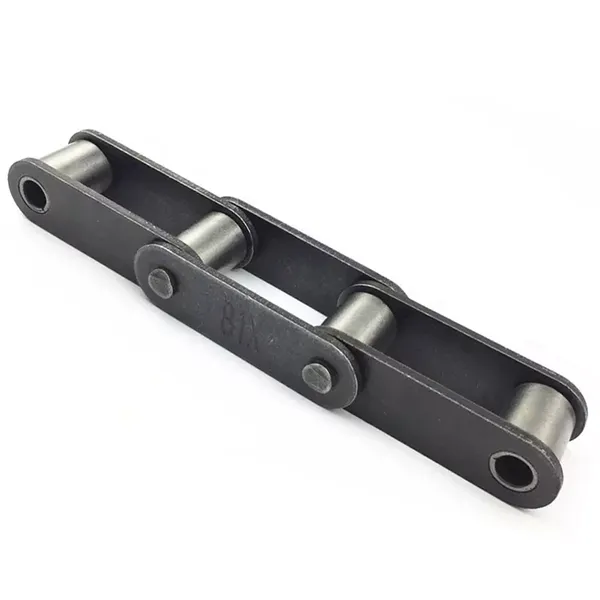
Free flow chian, also called plus speed chain, accumulation chain, Differential chain.
Free flow chian, also called plus speed chain, accumulation chain, Differential chain.
It is a popular chain used in pallet/tray conveyor system.
Free flow chian, also called plus speed chain, accumulation chain, Differential chain.
Free flow chain is 1 of the major products of Seikonveyor. Its production is finished in automatic factory. In every month CZPT factory supplys over 500000 CZPT free flow chain to the market. Include different materials types: Nylon, steel, stainless steel. and different color: black, blue, brown. Our free flow chain is widely used in automatic conveyor system, especially for different kinds of assembly lines
BS25 free flow chain production view
Free flow chian, also called plus speed chain, accumulation chain, Differential chain.
BS30 free flow chain production view
Free flow chian, also called plus speed chain, accumulation chain, Differential chain.
We pick perfect rollers to assemble the free flow chain, to ensure the chain run smooth
Free flow chian, also called plus speed chain, accumulation chain, Differential chain.
Bulk production makes our free flow chain with competitive price in the martke.
Free flow chian, also called plus speed chain, accumulation chain, Differential chain.
For bulk order, we provide plywood crate package to protect it from damage during transportation.
| Matériel: | Plastique |
|---|---|
| Structure: | Chaîne à rouleaux |
| Traitement de surface : | galvanoplastie |
| Fonctionnalité: | Résistant au feu, à l'huile et à la chaleur |
| Chain 3: | 3 Speed Chain |
| Chain 2: | Speed Chain |
| Exemples : |
US$ 20/Mètre
1 mètre (commande minimale) | |
|---|
| Personnalisation : |
Disponible
| Demande personnalisée |
|---|
Comment une chaîne de convoyage gère-t-elle le transport en pente ou en déclinaison ?
Une chaîne de convoyage est conçue pour gérer différents types de transport, y compris les applications inclinées ou descendantes. Voici comment elle fonctionne dans ces situations :
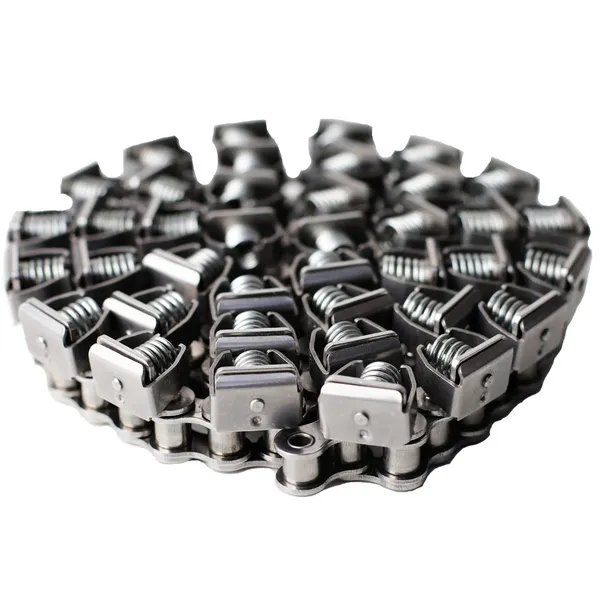
1. Convoyage en pente : Lorsqu’un système de convoyage doit transporter des matériaux en montée, on utilise une chaîne de convoyage inclinée. La conception de cette chaîne comprend des fixations ou des crampons spéciaux qui offrent une meilleure adhérence et empêchent les matériaux de glisser ou de reculer. Ces fixations sont positionnées stratégiquement le long de la chaîne pour garantir un convoyage efficace en pente.
2. Convoyage en pente : Pour les convoyeurs transportant des matériaux en descente, on utilise une chaîne de convoyeur en pente. Similaire à celle des convoyeurs inclinés, la chaîne peut être équipée de dispositifs ou de crampons spécifiques permettant de contrôler la vitesse et d'empêcher le glissement trop rapide des matériaux. Ces dispositifs maintiennent les matériaux en place et assurent un flux descendant contrôlé et efficace.
Le convoyage, qu'il soit incliné ou en descente, exige une attention particulière quant à la conception de la chaîne, notamment au type et à la disposition des accessoires. La taille, la forme et le poids du matériau transporté influent également sur la configuration de chaîne appropriée. Il est essentiel de consulter des fabricants ou des experts en chaînes de convoyage afin de sélectionner la chaîne et les accessoires adaptés à chaque application, inclinée ou en descente.
How do you calculate the power requirements for a conveyor chain?
Calculating the power requirements for a conveyor chain involves considering various factors. Here’s a step-by-step process:
1. Determine the total weight to be transported: Measure or estimate the total weight of the material or product that will be carried by the conveyor chain. This includes the weight of the product itself, any packaging, and additional loads.
2. Determine the speed of the conveyor: Determine the desired speed at which the conveyor chain will operate. This is typically measured in feet per minute (FPM) or meters per second (m/s).
3. Calculate the required capacity: Multiply the total weight by the desired speed to determine the required capacity of the conveyor system. This will give you the weight per unit of time (e.g., pounds per minute or kilograms per hour).
4. Consider the conveyor’s design factors: Take into account various design factors such as the type and pitch of the conveyor chain, the coefficient of friction between the chain and the conveyor components, and any incline or decline angles of the conveyor system. These factors affect the power requirements.
5. Determine the required power: Use the following formula to calculate the power requirements:
Power (in horsepower) = (Capacity × Friction Factor) ÷ (33,000 × Efficiency)
Where:
– Capacity is the weight per unit of time (from step 3)
– Friction Factor is the ratio of chain tension to chain weight, taking into account the design factors
– 33,000 is a conversion factor to convert the units to horsepower
– Efficiency is the overall efficiency of the conveyor system, typically expressed as a decimal value (e.g., 0.95 for 95% efficiency)
6. Select a suitable motor: Based on the calculated power requirements, select a motor that can provide the necessary power to drive the conveyor chain. Consider factors such as motor type, motor efficiency, and overload capacity.
It’s important to note that the power requirements may vary depending on specific conveyor system designs and operating conditions. Consulting with a qualified engineer or conveyor manufacturer is recommended to ensure accurate calculations and proper motor selection.
What is a conveyor chain and how does it work?
A conveyor chain is a type of mechanical chain specifically designed for use in conveyor systems. It is composed of a series of interconnected links that form a continuous chain loop. The links are typically made of metal and are joined together through pins or other connecting elements.
Conveyor chains work by transferring power and motion from the driving mechanism, such as a motor or sprocket, to the conveyor system to move materials or products along a predetermined path. The chain is placed on a track or guide rails, and as it moves, it carries the load placed on it.
The operation of a conveyor chain involves the following steps:
- Power transmission:
The driving mechanism transfers rotational power to the conveyor chain, typically through a motor and sprockets. The motor provides the necessary torque to drive the chain.
- Traction and motion:
As the driving mechanism rotates the sprockets, the teeth of the sprockets engage with the links of the conveyor chain. This interaction creates traction, causing the chain to move along the desired path.
- Load carrying:
The load to be transported is placed on the conveyor chain. The load can be in the form of products, materials, or other items. As the chain moves, it carries the load along the conveyor system, allowing for efficient transportation or handling.
- Support and guidance:
The conveyor chain is supported and guided by various components, such as guide rails, rollers, or wear strips. These components ensure the proper alignment and smooth movement of the chain along the conveyor system.
Conveyor chains are commonly used in industries such as manufacturing, logistics, packaging, and material handling. They offer a reliable and efficient method for moving products or materials in a controlled and automated manner.


editor by CX 2023-08-05