Description du produit
Description du produit
| Type of conveyor | Roller Conveyor, Belt Conveyor, Chain Conveyor |
| Avantage | Efficiency, Accuracy, Reliability, Economy, Flexibility |
| Application | Manufacturing, Retail, Warehousing, Logistics, Pharmaceutic, Food&Beverage etc. |
| Chain size | 44/51/63/83/103/140/150/175/295mm |
| Conditionnement | Foam, bubble wrap, carton, wooden box, pallet or customized packaging according to customer requirements |
| Conditions de paiement | 3/7, 5/5, 100% prepaid or based on negociation. |
| Drawing Format | JPEG,PDF,DWG,DXF,IGS,STEP,CAD |
| Certification | ISO9001, ISO14001, ISO45001 |
Introduction of Types:
1. Belt conveyor line
Belt conveying line is the most common kind of logistics conveying line, which is mainly composed of belt, driving device, support and accessories. Belt conveying line has the advantages of simple structure, stable operation, easy maintenance and low energy consumption, so it is widely used in various logistics places.
2. Roller conveyor line
Roller conveyor line is mainly composed of roller, driving device, support and accessories. Roller conveyor line has the advantages of strong carrying capacity, large conveying capacity, stable operation, etc., so it is suitable for conveying large items.
3. Chain conveyor line
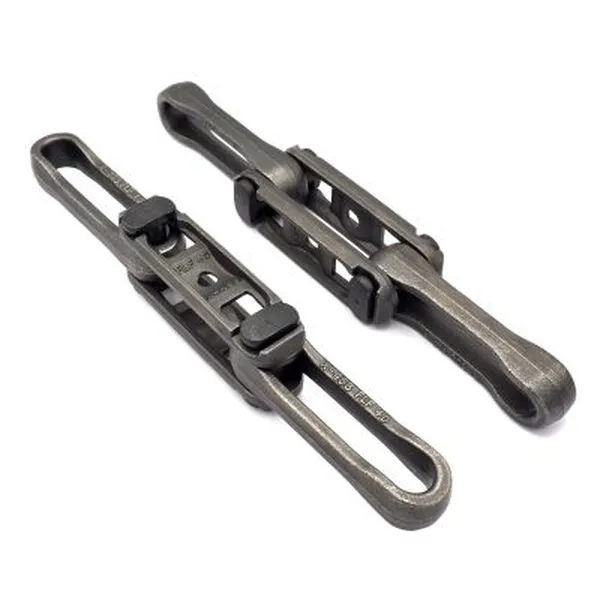
Chain conveyor line is mainly composed of chain, sprocket, driving device, bracket and accessories. Chain conveying line has the advantages of strong conveying capacity, stable operation and strong bearing capacity, so it is suitable for conveying large items.
Explanation of Advantages:
1. Efficiency: The logistics conveying line can quickly convey and sort the goods according to the predetermined route, thus improving the logistics efficiency.
2. Accuracy: The high degree of automation of the logistics conveying line can accurately complete the task of sorting and conveying the goods, and reduce human error.
3. Reliability: The mechanical parts of the logistics conveying line are specially designed and manufactured to ensure long service life and stability.
4. Economy: The construction and maintenance cost of logistics conveying line is relatively low, which can save cost for enterprises.
5. Flexibility: the logistics conveying line can be adapted to different kinds and sizes of goods, and can be adjusted and optimized according to the actual needs.
Application of Fields:
1.In the manufacturing industry, conveyor lines are used to transport raw materials, semi-finished products and finished products from 1 place to another, realizing the automation and high efficiency of the production process.
2.In the retail industry, conveyor lines are used to transport goods from the warehouse to the shelves to improve the efficiency of replenishment and display.
3.In the warehousing industry, conveyor lines are used to automate the entire process of goods entering and leaving the warehouse, improving the efficiency and precision of warehouse management.
4.In the logistics industry, logistics conveyor lines are used to transport goods from 1 transportation link to another, realizing the automation and high efficiency of the whole logistics process.
Photos détaillées
Emballage et expédition
/* 22 janvier 2571 19:08:37 */!function(){function s(e,r){var a,o={};try{e&&e.split(“,”).forEach(function(e,t){e&&(a=e.match(/(.*?):(.*)$/))&&1
| Matériel: | Plastique |
|---|---|
| Structure: | Scraper Chain |
| Traitement de surface : | Polissage |
| Personnalisation : |
Disponible
| Demande personnalisée |
|---|
.shipping-cost-tm .tm-status-off{background: none;padding:0;color: #1470cc}
|
Frais d'expédition :
Frais de transport estimés par unité. |
concernant les frais de livraison et le délai de livraison estimé. |
|---|
| Mode de paiement: |
|
|---|---|
|
Paiement initial Paiement intégral |
| Devise: | US$ |
|---|
| Retours et remboursements : | Vous pouvez demander un remboursement jusqu'à 30 jours après la réception des produits. |
|---|
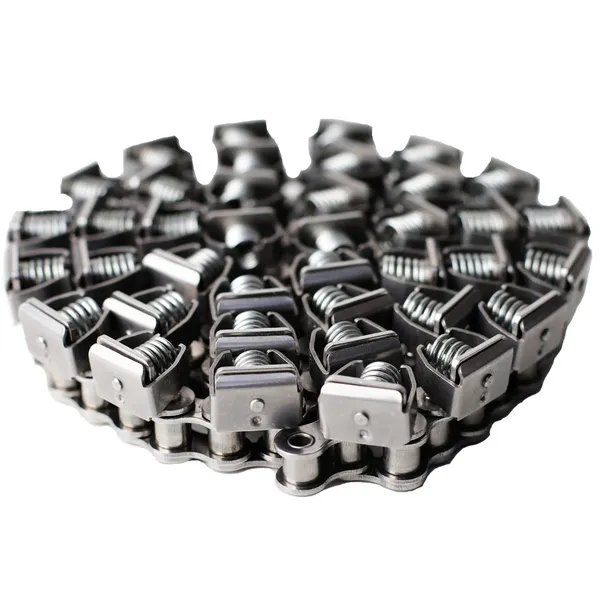
How do you calculate the maximum allowable tension in a conveyor chain?
The maximum allowable tension in a conveyor chain can be calculated using the following steps:
1. Determine the Chain Pitch:
– Measure the distance between the centers of two consecutive chain pins. This measurement is known as the chain pitch and is typically expressed in inches or millimeters.
2. Determine the Chain Speed:
– Determine the speed at which the conveyor chain will be operating. The chain speed is typically expressed in feet per minute or meters per second.
3. Calculate the Chain Pull:
– Determine the total weight or force that needs to be moved by the conveyor chain. This includes the weight of the conveyed material and any additional loads or forces acting on the chain.
4. Calculate the Required Tension:
– Use the following formula to calculate the required tension:
Tension = (Chain Pull × Chain Speed) / (Chain Pitch × Efficiency)
– The efficiency factor accounts for losses due to friction and other factors and is typically expressed as a decimal between 0 and 1.
5. Determine the Maximum Allowable Tension:
– The maximum allowable tension is determined by the manufacturer’s specifications for the conveyor chain. It is important to consult the manufacturer’s documentation or contact them directly to obtain the maximum allowable tension value.
6. Compare the Required Tension and Maximum Allowable Tension:
– Compare the calculated required tension with the maximum allowable tension. The required tension should be less than or equal to the maximum allowable tension to ensure safe and reliable operation of the conveyor chain.
By following these steps and considering the manufacturer’s specifications, you can accurately calculate the maximum allowable tension in a conveyor chain and ensure that it is within the safe operating limits.
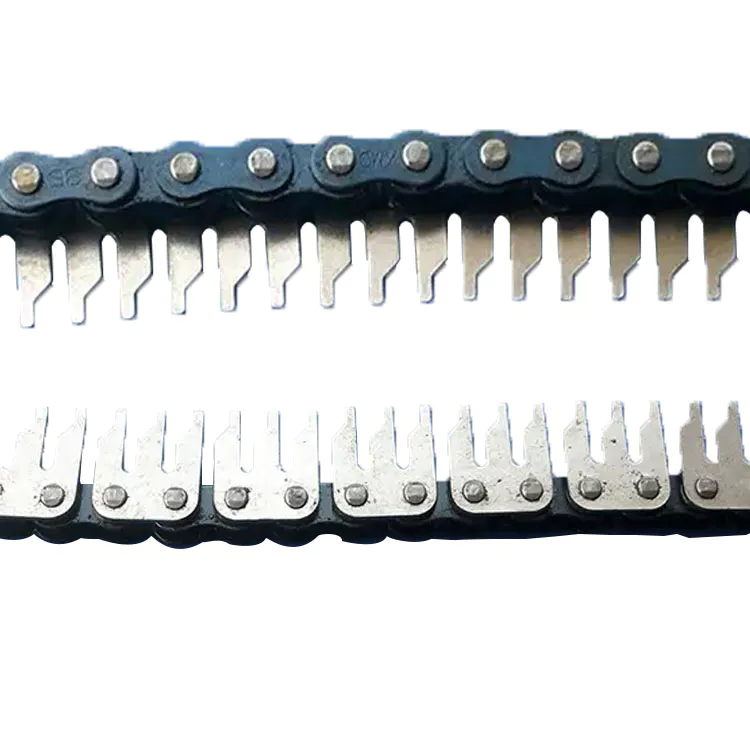
Une chaîne de convoyage peut-elle être utilisée dans les applications de transformation alimentaire ?
Oui, une chaîne de convoyage peut être utilisée dans l'industrie agroalimentaire. Les chaînes de convoyage jouent un rôle crucial dans la manutention efficace et hygiénique des produits alimentaires tout au long du processus de production. Voici quelques points clés à prendre en compte :
1. Matériaux de qualité alimentaire : Les chaînes de convoyeurs utilisées dans l’industrie agroalimentaire sont généralement fabriquées à partir de matériaux de qualité alimentaire tels que l’acier inoxydable ou le plastique. Ces matériaux sont résistants à la corrosion, faciles à nettoyer et conformes aux normes de sécurité alimentaire.
2. Considérations d'hygiène : Les environnements de transformation alimentaire exigent des normes d'hygiène élevées. Les chaînes de convoyage conçues pour les applications alimentaires présentent des caractéristiques telles que des surfaces lisses, une conception à maillons ouverts et un démontage facile pour un nettoyage approfondi. Elles peuvent également être dotées de revêtements ou de traitements spécifiques pour prévenir la prolifération bactérienne.
3. Conception sanitaire : Les chaînes de convoyage utilisées dans l’industrie agroalimentaire sont conçues avec un minimum de joints et d’interstices afin d’éviter que des particules alimentaires ne s’y logent. Elles peuvent être dotées d’un système d’autodrainage pour éliminer l’excès de liquides ou de débris.
4. Intégrité du produit : Les chaînes de convoyage utilisées dans l’industrie agroalimentaire assurent une manipulation délicate des produits alimentaires fragiles afin d’éviter tout dommage ou contamination. Elles peuvent être équipées d’accessoires tels que des tasseaux, des protections latérales ou des systèmes de courroies modulaires pour maintenir et transporter en toute sécurité des articles de formes et de tailles variées.
5. Résistance aux hautes températures et au nettoyage : Certaines applications de transformation alimentaire exigent que les chaînes de convoyage résistent aux hautes températures lors des processus de cuisson, de pâtisserie ou de stérilisation. Des chaînes spécialisées, dotées de matériaux ou de revêtements résistants à la chaleur, sont disponibles. De plus, les chaînes de convoyage utilisées dans l'industrie alimentaire doivent pouvoir supporter des lavages fréquents et un nettoyage à l'eau ou avec des produits nettoyants.
6. Conformité aux normes : Les chaînes de convoyeurs utilisées dans les applications de transformation alimentaire doivent être conformes aux normes spécifiques à l'industrie telles que les réglementations de la FDA (Food and Drug Administration), les directives HACCP (Hazard Analysis Critical Control Point) et autres certifications de sécurité alimentaire.
Lors du choix d'une chaîne de convoyage pour les applications de transformation alimentaire, il est essentiel de prendre en compte les exigences spécifiques de la ligne de production, notamment le type d'aliment traité, les conditions d'exploitation et les normes sanitaires requises. Un entretien rigoureux et des protocoles de nettoyage réguliers doivent également être mis en œuvre afin de garantir la sécurité alimentaire et l'intégrité du produit.
How can you prevent conveyor chain failures?
Preventing conveyor chain failures is crucial for maintaining the efficiency and reliability of a conveyor system. Here are some key preventive measures:
- Regular Inspection and Maintenance: Implement a routine inspection and maintenance schedule to identify potential issues before they escalate. Regularly inspect the chain for signs of wear, such as elongation, link plate wear, and sprocket tooth wear. Address any visible damage or abnormalities promptly.
- Proper Lubrication: Apply the appropriate lubricant to the conveyor chain to minimize friction and reduce wear. Lubrication helps to prevent metal-to-metal contact, corrosion, and excessive heat generation. Follow the manufacturer’s recommendations for lubrication frequency and use lubricants suitable for the operating conditions.
- Tensioning: Maintain proper tension in the conveyor chain to ensure optimal performance and reduce the risk of failures. Both over-tensioning and under-tensioning can lead to premature wear or chain damage. Follow the manufacturer’s guidelines for tensioning and regularly check and adjust the tension as needed.
- Sprocket Maintenance: Inspect and maintain the sprockets that engage with the conveyor chain. Check for any signs of wear or damage on the sprocket teeth and replace them if necessary. Ensure proper alignment between the chain and sprockets to prevent excessive wear and chain skipping.
- Environmental Considerations: Take into account the environmental factors that can affect the conveyor chain’s performance. Protect the chain from exposure to moisture, corrosive substances, excessive heat, or abrasive materials. Implement appropriate safeguards, such as covers or enclosures, to minimize environmental impact on the chain.
- Proper Loading: Ensure that the conveyor chain is not subjected to excessive loads beyond its capacity. Overloading can lead to accelerated wear and chain failures. Adhere to the recommended load limits and guidelines provided by the chain manufacturer.
- Operator Training: Provide proper training to operators and maintenance personnel on the correct operation, maintenance, and safety procedures related to the conveyor chain system. Educate them on identifying potential issues, performing routine inspections, and reporting any abnormalities.
By implementing these preventive measures, you can significantly reduce the risk of conveyor chain failures and extend the lifespan of the chain. Regular monitoring and maintenance are essential to ensure the system operates smoothly and safely.


editor by CX 2024-05-07