
Penerangan Produk
Penerangan Produk
| Type of conveyor | Roller Conveyor, Belt Conveyor, Chain Conveyor |
| Advantage | Efficiency, Accuracy, Reliability, Economy, Flexibility |
| Permohonan | Manufacturing, Retail, Warehousing, Logistics, Pharmaceutic, Food&Beverage etc. |
| Chain size | 44/51/63/83/103/140/150/175/295mm |
| Packaging | Foam, bubble wrap, carton, wooden box, pallet or customized packaging according to customer requirements |
| Payment Terms | 3/7, 5/5, 100% prepaid or based on negociation. |
| Drawing Format | JPEG,PDF,DWG,DXF,IGS,STEP,CAD |
| Certification | ISO9001, ISO14001, ISO45001 |
Introduction of Types:
1. Belt conveyor line
Belt conveying line is the most common kind of logistics conveying line, which is mainly composed of belt, driving device, support and accessories. Belt conveying line has the advantages of simple structure, stable operation, easy maintenance and low energy consumption, so it is widely used in various logistics places.
2. Roller conveyor line
Roller conveyor line is mainly composed of roller, driving device, support and accessories. Roller conveyor line has the advantages of strong carrying capacity, large conveying capacity, stable operation, etc., so it is suitable for conveying large items.
3. Chain conveyor line
Chain conveyor line is mainly composed of chain, sprocket, driving device, bracket and accessories. Chain conveying line has the advantages of strong conveying capacity, stable operation and strong bearing capacity, so it is suitable for conveying large items.
Explanation of Advantages:
1. Efficiency: The logistics conveying line can quickly convey and sort the goods according to the predetermined route, thus improving the logistics efficiency.
2. Accuracy: The high degree of automation of the logistics conveying line can accurately complete the task of sorting and conveying the goods, and reduce human error.
3. Reliability: The mechanical parts of the logistics conveying line are specially designed and manufactured to ensure long service life and stability.
4. Economy: The construction and maintenance cost of logistics conveying line is relatively low, which can save cost for enterprises.
5. Flexibility: the logistics conveying line can be adapted to different kinds and sizes of goods, and can be adjusted and optimized according to the actual needs.
Application of Fields:
1.In the manufacturing industry, conveyor lines are used to transport raw materials, semi-finished products and finished products from 1 place to another, realizing the automation and high efficiency of the production process.
2.In the retail industry, conveyor lines are used to transport goods from the warehouse to the shelves to improve the efficiency of replenishment and display.
3.In the warehousing industry, conveyor lines are used to automate the entire process of goods entering and leaving the warehouse, improving the efficiency and precision of warehouse management.
4.In the logistics industry, logistics conveyor lines are used to transport goods from 1 transportation link to another, realizing the automation and high efficiency of the whole logistics process.
Detailed Photos
Packaging & Shipping
/* 22 Januari 2571 19:08:37 */!function(){function s(e,r){var a,o={};try{e&&e.split(“,”).forEach(function(e,t){e&&(a=e.match(/(.*?):(.*)$/)&
| Bahan: | Plastic |
|---|---|
| Struktur: | Scraper Chain |
| Rawatan Permukaan: | Polishing |
| Penyesuaian: |
Tersedia
| Permintaan Tersuai |
|---|
.shipping-cost-tm .tm-status-off{background: none;padding:0;color: #1470cc}
|
Shipping Cost:
Estimated freight per unit. |
about shipping cost and estimated delivery time. |
|---|
| Payment Method: |
|
|---|---|
|
Initial Payment Full Payment |
| Currency: | US$ |
|---|
| Return&refunds: | You can apply for a refund up to 30 days after receipt of the products. |
|---|
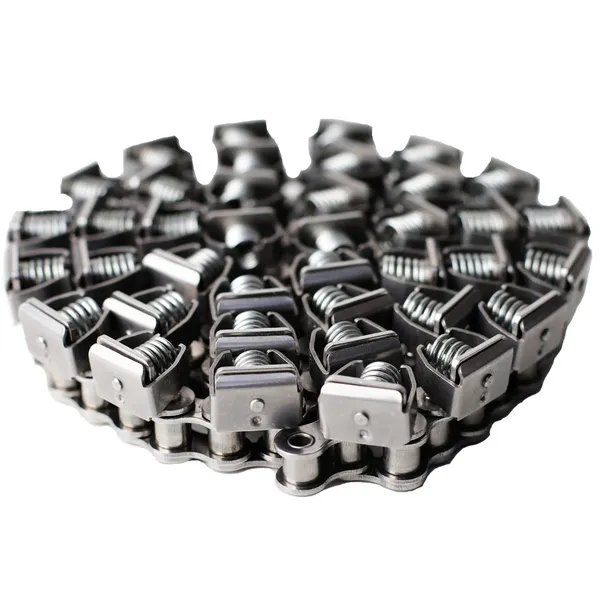
How do you calculate the maximum allowable tension in a conveyor chain?
The maximum allowable tension in a conveyor chain can be calculated using the following steps:
1. Determine the Chain Pitch:
– Measure the distance between the centers of two consecutive chain pins. This measurement is known as the chain pitch and is typically expressed in inches or millimeters.
2. Determine the Chain Speed:
– Determine the speed at which the conveyor chain will be operating. The chain speed is typically expressed in feet per minute or meters per second.
3. Calculate the Chain Pull:
– Determine the total weight or force that needs to be moved by the conveyor chain. This includes the weight of the conveyed material and any additional loads or forces acting on the chain.
4. Calculate the Required Tension:
– Use the following formula to calculate the required tension:
Tension = (Chain Pull × Chain Speed) / (Chain Pitch × Efficiency)
– The efficiency factor accounts for losses due to friction and other factors and is typically expressed as a decimal between 0 and 1.
5. Determine the Maximum Allowable Tension:
– The maximum allowable tension is determined by the manufacturer’s specifications for the conveyor chain. It is important to consult the manufacturer’s documentation or contact them directly to obtain the maximum allowable tension value.
6. Compare the Required Tension and Maximum Allowable Tension:
– Compare the calculated required tension with the maximum allowable tension. The required tension should be less than or equal to the maximum allowable tension to ensure safe and reliable operation of the conveyor chain.
By following these steps and considering the manufacturer’s specifications, you can accurately calculate the maximum allowable tension in a conveyor chain and ensure that it is within the safe operating limits.
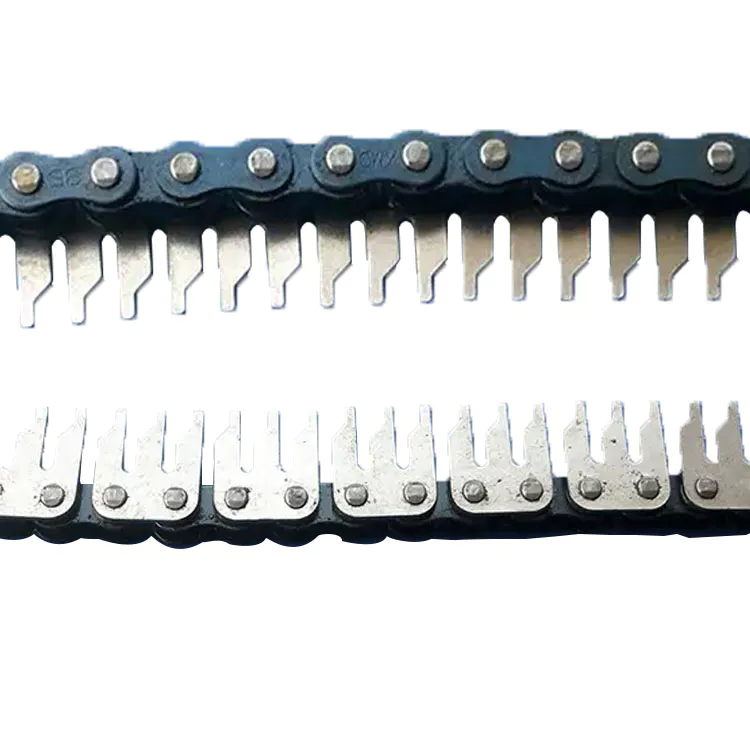
Can a conveyor chain be used in food processing applications?
Yes, a conveyor chain can be used in food processing applications. Conveyor chains play a crucial role in the efficient and hygienic handling of food products throughout the production process. Here are some key points to consider:
1. Food-Grade Materials: Conveyor chains used in food processing applications are typically made from food-grade materials such as stainless steel or plastic. These materials are corrosion-resistant, easy to clean, and comply with food safety regulations.
2. Hygiene Considerations: Food processing environments require high standards of hygiene. Conveyor chains designed for food applications incorporate features such as smooth surfaces, open link designs, and easy disassembly for thorough cleaning. They may also have specialized coatings or treatments to prevent bacterial growth.
3. Sanitary Design: Conveyor chains for food processing applications are designed with minimal crevices or joints to prevent food particles from getting trapped. They may have self-draining capabilities to remove excess fluids or debris.
4. Product Integrity: Conveyor chains in food processing applications ensure gentle handling of delicate food products to avoid damage or contamination. They can be equipped with accessories like cleats, side guards, or modular belt systems to securely hold and transport items of various shapes and sizes.
5. High Temperature and Washdown Capabilities: Some food processing applications require conveyor chains to withstand high temperatures during cooking, baking, or sterilization processes. Specialized chains with heat-resistant materials or coatings are available. Additionally, conveyor chains used in food processing should be capable of withstanding frequent washdowns and cleaning with water or cleaning agents.
6. Compliance with Standards: Conveyor chains used in food processing applications must comply with industry-specific standards such as FDA (Food and Drug Administration) regulations, HACCP (Hazard Analysis Critical Control Point) guidelines, and other food safety certifications.
When selecting a conveyor chain for food processing applications, it is important to consider the specific requirements of the production line, including the type of food being handled, the operating conditions, and the necessary sanitary standards. Proper maintenance and regular cleaning protocols should also be implemented to ensure food safety and product integrity.
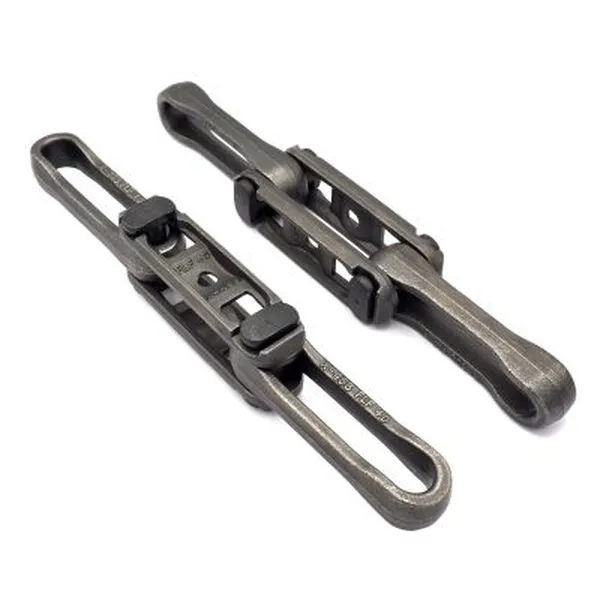
Bagaimanakah anda boleh mencegah kegagalan rantai penghantar?
Mencegah kegagalan rantai penghantar adalah penting untuk mengekalkan kecekapan dan kebolehpercayaan sistem penghantar. Berikut adalah beberapa langkah pencegahan utama:
- Pemeriksaan dan Penyelenggaraan Berkala: Laksanakan jadual pemeriksaan dan penyelenggaraan rutin untuk mengenal pasti potensi masalah sebelum ia menjadi lebih teruk. Periksa rantai secara berkala untuk tanda-tanda haus, seperti pemanjangan, haus plat pautan dan haus gigi sproket. Tangani sebarang kerosakan atau keabnormalan yang ketara dengan segera.
- Pelinciran yang betul: Sapukan pelincir yang sesuai pada rantai penghantar untuk meminimumkan geseran dan mengurangkan haus. Pelinciran membantu mencegah sentuhan logam ke logam, kakisan dan penjanaan haba yang berlebihan. Ikut cadangan pengilang untuk kekerapan pelinciran dan gunakan pelincir yang sesuai untuk keadaan operasi.
- Ketegangan: Kekalkan tegangan yang betul dalam rantai penghantar untuk memastikan prestasi optimum dan mengurangkan risiko kegagalan. Kedua-dua tegangan berlebihan dan tegangan terkurang boleh menyebabkan haus pramatang atau kerosakan rantai. Ikut garis panduan pengeluar untuk tegangan dan periksa serta laraskan tegangan secara berkala mengikut keperluan.
- Penyelenggaraan Sproket: Periksa dan selenggara gegancu yang bersambung dengan rantai penghantar. Periksa sebarang tanda haus atau kerosakan pada gigi gegancu dan gantikannya jika perlu. Pastikan penjajaran yang betul antara rantai dan gegancu untuk mengelakkan haus berlebihan dan rantai terlepas.
- Pertimbangan Alam Sekitar: Ambil kira faktor persekitaran yang boleh menjejaskan prestasi rantai penghantar. Lindungi rantai daripada pendedahan kepada kelembapan, bahan menghakis, haba berlebihan atau bahan kasar. Laksanakan perlindungan yang sesuai, seperti penutup atau penutup, untuk meminimumkan kesan alam sekitar pada rantai.
- Pemuatan yang Betul: Pastikan rantai penghantar tidak dikenakan beban berlebihan melebihi kapasitinya. Beban berlebihan boleh menyebabkan haus yang dipercepat dan kegagalan rantai. Patuhi had beban dan garis panduan yang disyorkan oleh pengeluar rantai.
- Latihan Pengendali: Berikan latihan yang betul kepada pengendali dan kakitangan penyelenggaraan tentang prosedur operasi, penyelenggaraan dan keselamatan yang betul berkaitan dengan sistem rantai penghantar. Didik mereka tentang mengenal pasti potensi masalah, melakukan pemeriksaan rutin dan melaporkan sebarang keabnormalan.
Dengan melaksanakan langkah-langkah pencegahan ini, anda boleh mengurangkan risiko kegagalan rantai penghantar dengan ketara dan memanjangkan jangka hayat rantai tersebut. Pemantauan dan penyelenggaraan yang kerap adalah penting untuk memastikan sistem beroperasi dengan lancar dan selamat.


editor by CX 2024-05-07