Description du produit
Description du produit
Free Flow Chian
BS25
| Chain Number | model | Pitch | Roller Dia. (D) | Roller Dia.(d) | Weight(kg/m) |
| BS25-C206B | SKVR25-1905 | 19.05 | 18.3 | 11.91 | 0.52 |
| BS25-C208A | SKVR25-2540 | 25.4 | 24.6 | 15.88 | 0.79 |
| BS25-C212A | SKVR25-3810 | 38.1 | 36.6 | 22.23 | 2.19 |
BS30
| Chain Number | model | Pitch | Roller Dia. (D) | Roller Dia.(d) | Weight(kg/m) |
| BS30-C212A | SKVR30-3810 | 38.1 | 38 | 18 | 2.14 |
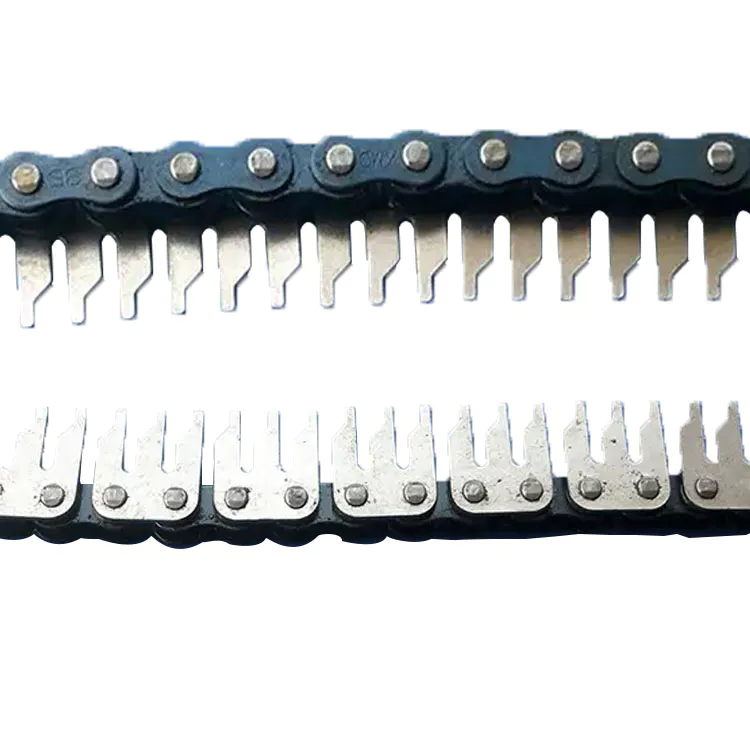
Free flow chian, also called plus speed chain, accumulation chain, Differential chain.
Free flow chian, also called plus speed chain, accumulation chain, Differential chain.
It is a popular chain used in pallet/tray conveyor system.
Free flow chian, also called plus speed chain, accumulation chain, Differential chain.
Free flow chain is 1 of the major products of Seikonveyor. Its production is finished in automatic factory. In every month CHINAMFG factory supplys over 500000 CHINAMFG free flow chain to the market. Include different materials types: Nylon, steel, stainless steel. and different color: black, blue, brown. Our free flow chain is widely used in automatic conveyor system, especially for different kinds of assembly lines
BS25 free flow chain production view
Free flow chian, also called plus speed chain, accumulation chain, Differential chain.
BS30 free flow chain production view
Free flow chian, also called plus speed chain, accumulation chain, Differential chain.
We pick perfect rollers to assemble the free flow chain, to ensure the chain run smooth
Free flow chian, also called plus speed chain, accumulation chain, Differential chain.
Bulk production makes our free flow chain with competitive price in the martke.
Free flow chian, also called plus speed chain, accumulation chain, Differential chain.
For bulk order, we provide plywood crate package to protect it from damage during transportation.
| Matériel: | Plastic |
|---|---|
| Structure: | Chaîne à rouleaux |
| Traitement de surface : | Electroplating |
| Feature: | Fire Resistant, Oil Resistant, Heat Resistant |
| Chain 3: | 3 Speed Chain |
| Chain 2: | Speed Chain |
| Exemples : |
US$ 20/Meter
1 Meter(Min.Order) | |
|---|
| Personnalisation : |
Disponible
| Demande personnalisée |
|---|

Une chaîne de convoyeur peut-elle être utilisée dans des applications à grande vitesse ?
Oui, une chaîne de convoyage peut être utilisée dans des applications à grande vitesse, en fonction de sa conception et de ses spécifications, ainsi que de celles du système de convoyage. Cependant, certains facteurs sont à prendre en compte lors de l'utilisation d'une chaîne de convoyage dans des applications à grande vitesse :
1. Conception de la chaîne : La chaîne du convoyeur doit être conçue pour supporter des vitesses élevées sans compromettre la sécurité ni les performances. Des chaînes haute vitesse spécifiques sont disponibles, conçues pour répondre aux exigences des applications à grande vitesse.
2. Choix des matériaux : Le matériau utilisé pour la fabrication de la chaîne de convoyeur doit présenter une résistance et une durabilité élevées afin de supporter les forces et les contraintes à grande vitesse. Les matériaux couramment utilisés pour les chaînes de convoyeurs à grande vitesse comprennent les aciers alliés, l’acier inoxydable et les polymères spéciaux.
3. Lubrification : Une lubrification adéquate est essentielle dans les applications à grande vitesse afin de réduire la friction, la chaleur et l’usure. Il convient d’utiliser des lubrifiants spécialement conçus pour les chaînes de convoyeurs à grande vitesse afin de garantir un fonctionnement optimal et d’allonger la durée de vie de la chaîne.
4. Tension et alignement : Une tension et un alignement précis de la chaîne du convoyeur sont essentiels pour les applications à grande vitesse. Une tension adéquate contribue à maintenir la stabilité de la chaîne et à prévenir les vibrations excessives ou l’allongement, qui peuvent entraîner une rupture ou une usure prématurée.
5. Considérations de sécurité : Les applications à grande vitesse nécessitent des mesures de sécurité supplémentaires pour protéger le personnel et les équipements. Des protections adéquates, des systèmes d’arrêt d’urgence et des inspections de maintenance régulières sont essentiels pour garantir un fonctionnement sûr.
Il est important de consulter le fabricant de la chaîne de convoyage ou un ingénieur pour déterminer si une chaîne spécifique convient aux applications à grande vitesse. Ils pourront vous conseiller sur le choix de la conception, du matériau, de la lubrification et des pratiques d'entretien appropriés afin de garantir un fonctionnement fiable et efficace à haute vitesse.
What are the advantages of using a plastic conveyor chain?
Plastic conveyor chains offer several advantages over traditional metal chains. Here are some of the key advantages:
1. Corrosion Resistance: Plastic chains are highly resistant to corrosion, making them ideal for applications in humid or corrosive environments. They do not rust or deteriorate when exposed to moisture or chemicals.
2. Lightweight: Plastic chains are significantly lighter than metal chains, making them easier to handle and install. Their lightweight nature reduces the overall weight of the conveyor system and can result in energy savings during operation.
3. Low Noise Operation: Plastic chains generate less noise compared to metal chains, leading to a quieter working environment. This can be particularly beneficial in industries where noise reduction is important, such as food processing or packaging.
4. Reduced Friction and Wear: Plastic chains have self-lubricating properties, which reduce friction and wear. This results in lower maintenance requirements and longer chain life. The smooth surface of plastic chains also minimizes the risk of product damage during transportation.
5. Flexibility and Modularity: Plastic chains can be easily customized and designed to fit specific conveyor system requirements. They offer flexibility in terms of length, width, and configuration. Additionally, plastic chains are often modular, allowing for easy replacement of damaged or worn-out sections without replacing the entire chain.
6. Cost-Effective: Plastic conveyor chains are generally more cost-effective compared to metal chains. They are often less expensive to manufacture and offer a longer lifespan with minimal maintenance requirements, resulting in lower overall costs.
7. Chemical Resistance: Plastic chains are resistant to a wide range of chemicals, making them suitable for applications where exposure to aggressive substances is a concern. They can withstand contact with oils, acids, alkalis, and various cleaning agents.
Overall, the advantages of using a plastic conveyor chain include corrosion resistance, lightweight design, low noise operation, reduced friction and wear, flexibility, cost-effectiveness, and chemical resistance. These benefits make plastic chains a popular choice in various industries, including food processing, packaging, pharmaceuticals, and logistics.
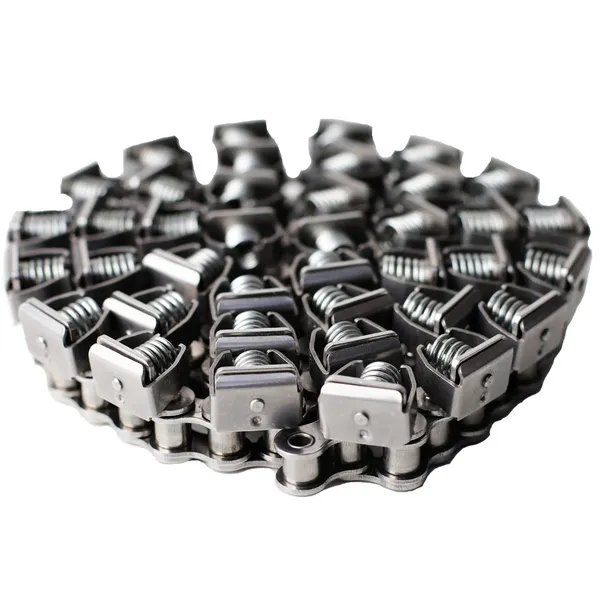
What is a conveyor chain and how does it work?
A conveyor chain is a type of mechanical chain specifically designed for use in conveyor systems. It is composed of a series of interconnected links that form a continuous chain loop. The links are typically made of metal and are joined together through pins or other connecting elements.
Conveyor chains work by transferring power and motion from the driving mechanism, such as a motor or sprocket, to the conveyor system to move materials or products along a predetermined path. The chain is placed on a track or guide rails, and as it moves, it carries the load placed on it.
The operation of a conveyor chain involves the following steps:
- Power transmission:
The driving mechanism transfers rotational power to the conveyor chain, typically through a motor and sprockets. The motor provides the necessary torque to drive the chain.
- Traction and motion:
As the driving mechanism rotates the sprockets, the teeth of the sprockets engage with the links of the conveyor chain. This interaction creates traction, causing the chain to move along the desired path.
- Load carrying:
The load to be transported is placed on the conveyor chain. The load can be in the form of products, materials, or other items. As the chain moves, it carries the load along the conveyor system, allowing for efficient transportation or handling.
- Support and guidance:
The conveyor chain is supported and guided by various components, such as guide rails, rollers, or wear strips. These components ensure the proper alignment and smooth movement of the chain along the conveyor system.
Conveyor chains are commonly used in industries such as manufacturing, logistics, packaging, and material handling. They offer a reliable and efficient method for moving products or materials in a controlled and automated manner.


editor by CX 2023-10-10