
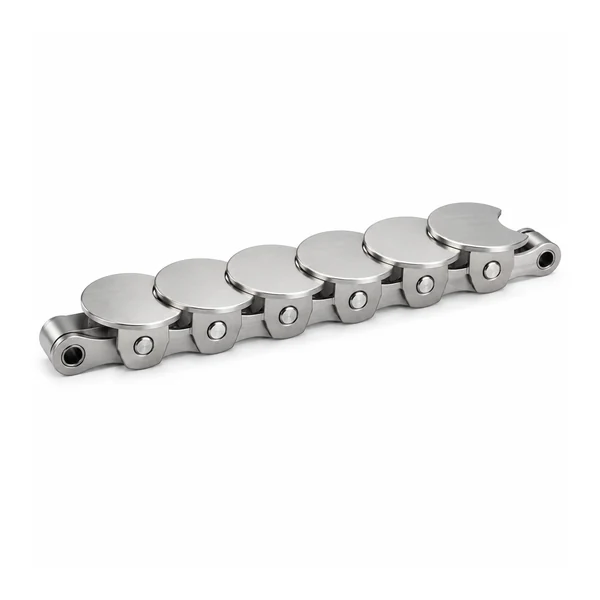
SSSC76.2B Sushi Conveyor Chain
SSSC76.2B stainless steel sushi conveyor chain with pitch, top-plate and chain-width dimensions for rotary restaurant conveyor replacement and OEM projects.
SSSC76.2B Sushi Conveyor Chain
This stainless steel sushi conveyor chain is built around a dedicated crescent-shaped top plate rather than a generic flat plastic module. The top plate creates a continuous carrying surface around curves while the central chain body supplies pitch control and articulation. For replacement work, the buyer should treat pitch, top-plate width, chain width and the interface to the guide track as one geometry set; matching only the nominal model name is not enough when the restaurant conveyor or guide rail has been modified. The series specification identifies the material family as 300, 400 and 600 series stainless steel. A quotation should therefore state the required material series or the existing material if known, together with photographs of the installed track and return path.
For replacement work, treat the crescent top plate, central chain body, guide track and drive sprocket as one interface. The part should be compared with the conveyor that exists today, including any guide, carrier or sprocket modifications made after the original machine was commissioned.
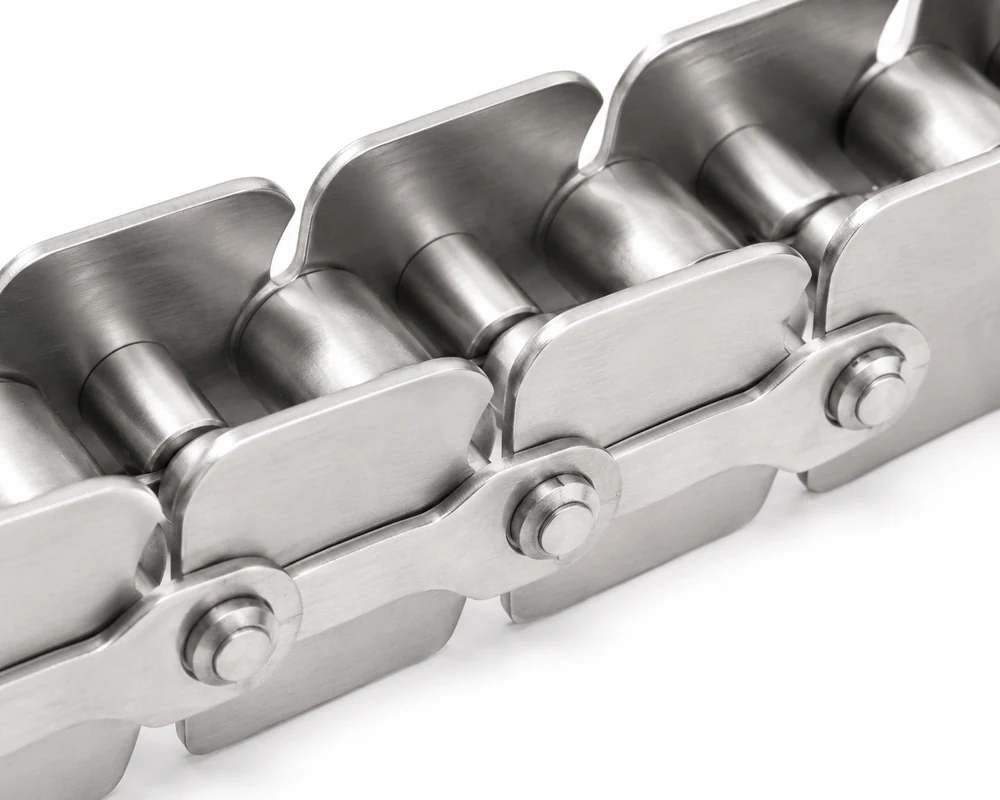
Sjekk funksjonene som styrer passform og bevegelse
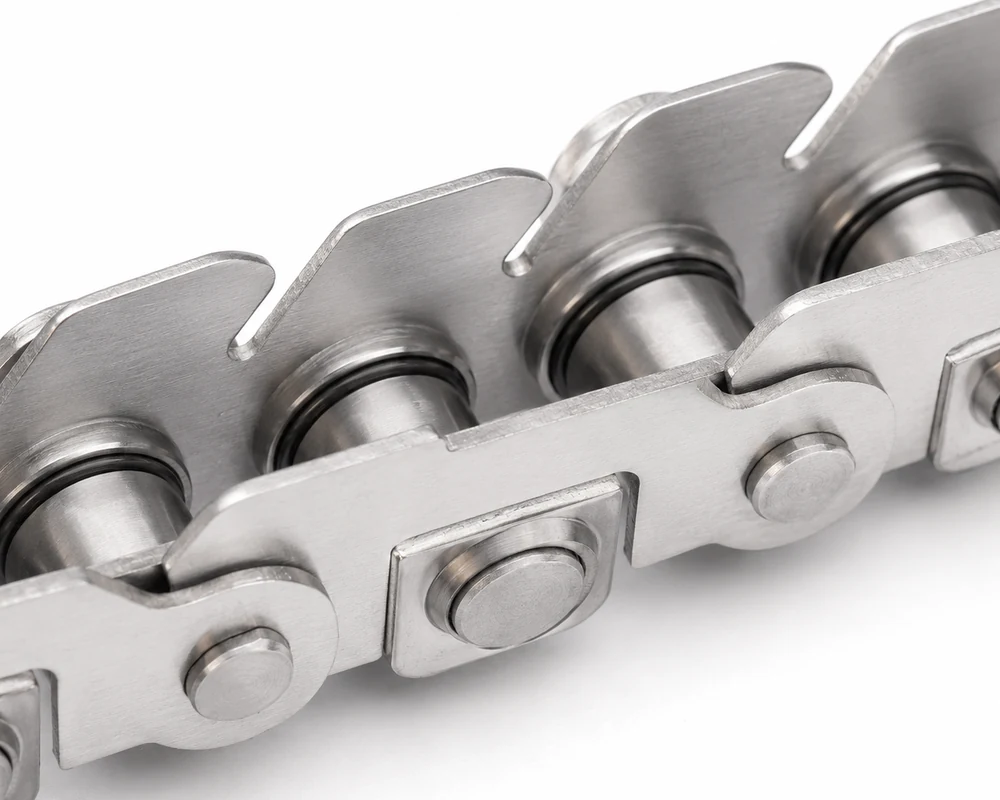
The key review points are curve clearance, return-path support and sprocket engagement. Measure several repeating features where possible instead of relying on one worn joint, rod or attachment. Photograph the component while it is still installed so running direction, guide contact and drive engagement are visible.
Selection starts with two measurements that are easy to verify on an installed line: center-to-center pitch and the effective top-plate width. Measure several pitches over a straight section to reduce single-joint error, then verify the overall chain width and roller diameter. Also record the smallest curve radius in the conveyor, the plate support arrangement, direction of travel and whether plates must pass under covers, dish guides or transfer points. If an existing chain runs quietly on the straight but binds in curves, the problem may be guide geometry, side clearance or accumulated pitch error rather than nominal pitch alone. For OEM projects, send a section drawing of the track and the mating sprocket before production approval.
Når dimensjonene er usikre, merk dem som målt fra en slitt prøve i stedet for å runde dem av til en antatt nominell verdi. Dette gjør det enklere å skille en reell dimensjonskonflikt fra normal slitasje under teknisk gjennomgang.
Teknisk tegning og spesifikasjon
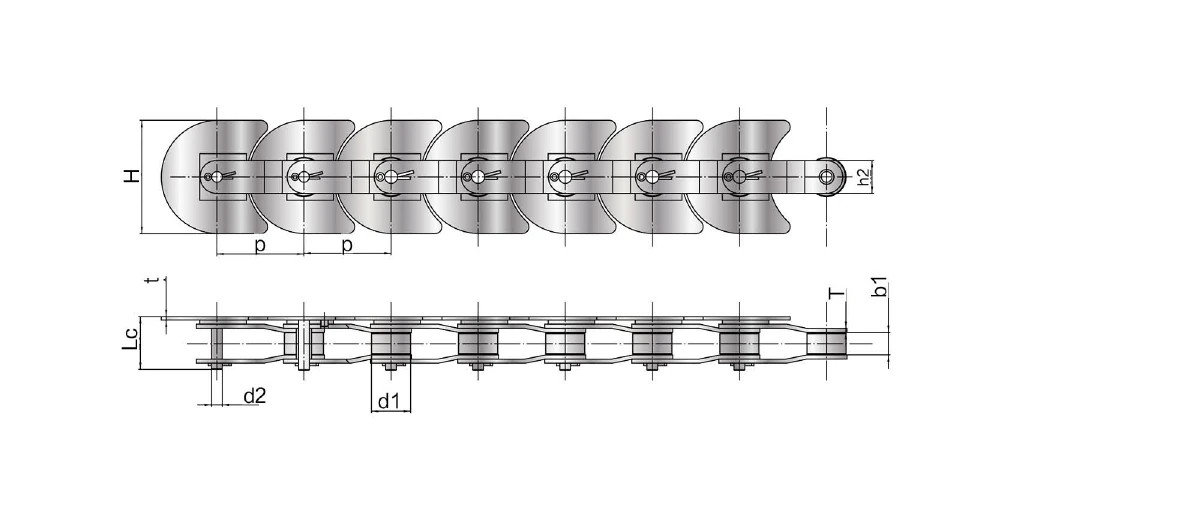
Dimension key: P = pitch; d1 = roller diameter; b1 = width between inner plates; d2 = pin diameter; H = top plate width; h2 = inner plate height; T = plate thickness; t = top plate thickness; Lc = chain width.
| Modell | Pitch P (mm) | Roller Diameter d1 (mm) | Width Between Inner Plates b1 (mm) | Pin Diameter d2 (mm) | Top Plate Width H (mm) | Inner Plate Height h2 (mm) | Plate Thickness T (mm) | Top Plate Thickness t (mm) | Chain Width Lc (mm) |
|---|---|---|---|---|---|---|---|---|---|
| SSSC76.2B | 76.20 | 49.50 | 19.00 | 7.92 | 112.00 | 22.00 | 2.50 | 2.50 | 42.00 |
Tabellen gjengir tilgjengelige modell-/konfigurasjonsdata for denne produktsiden. Verdier som ikke er oppført her, bør bekreftes fra prosjekttegningen, gjeldende komponent eller maskingrensesnittet, og ikke utledes fra en annen serie.
Evaluer komponenten innenfor hele transportbåndsbanen
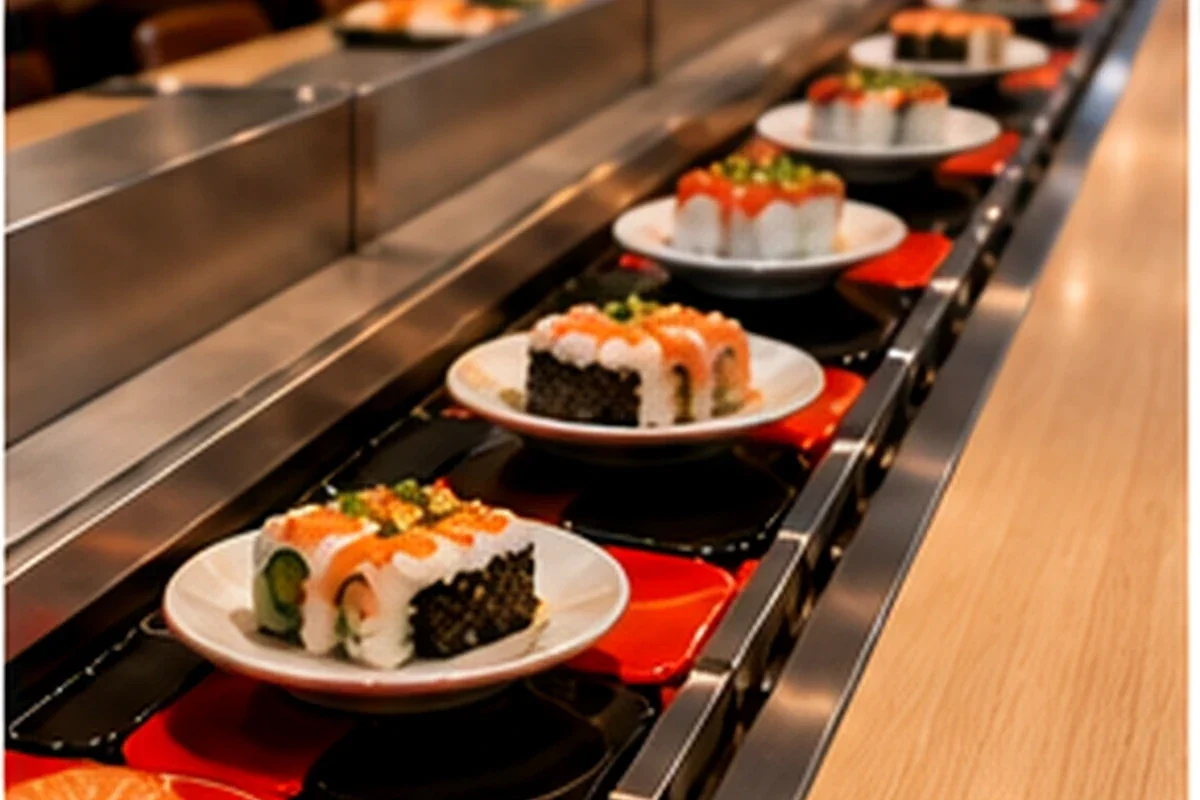
SSSC76.2B Sushi Conveyor Chain is considered for rotary sushi and plate-conveyor systems. In addition to the component dimensions, state the product being conveyed, spacing, line speed, starts and stops, curve or incline conditions, process zones and sanitation method. These operating inputs help identify the interfaces that deserve extra attention during approval.
Inspiser drivverket, støttene, overføringspunktene og returbanen for slitasje eller modifikasjon. Hvis skaden gjentar seg på én maskinposisjon, må du korrigere grensesnittet før du vurderer en ny kjede eller rem. En erstatningskomponent kan ikke kompensere for et grat, feiljustert føringsverk, skadet tannhjul eller ustøttet overføring.
Start ved lav hastighet før normal produksjon
During installation, clean the track and return rail before laying in the new chain, then verify that the chain can articulate freely through the tightest curve without forcing the top plates against fixed guides. Sprocket engagement should be checked by hand over several revolutions before powered commissioning. Initial testing should be performed empty, followed by representative dish loads distributed around the loop. Watch for localized lift, plate-to-guide contact, cyclic noise and changes in chain tension as the loop moves through transitions. These observations are more useful than simply checking that the conveyor can run at full speed.
Etter den første tomme kjøringen, sammenlign de samme observasjonspunktene under representativ belastning. Registrer eventuelle endringer i sideveis posisjon, artikulasjon, overføringsstøt, støy eller opptaksposisjon. En kort, repeterbar igangkjøringslogg gjør det enklere å skille normal innkjøring fra et maskingrensesnittproblem som krever korrigering før rutinemessig produksjon.
Rengjør og kontroller tannhjul, føringer, støtter og overføringer før du monterer den nye komponenten.
Bekreft løperetning, sideveis posisjon og inngrep uten å tvinge komponenten inn i sporet.
Følg et markert skjøt eller belterekke gjennom hele sløyfen med lavest mulig hastighet.
Introduser representativ lasting og sjekk på nytt overføring, kurve, sporing og returbaneatferd.
Hold bæreflaten og leddpunktene synlige
For food-service duty, cleaning access is part of the mechanical design. Remove product debris from the plate interfaces and guide path without levering the plates sideways. Use cleaning chemistry that is compatible with the specified stainless steel and any non-metallic guide components in the conveyor. After washdown, inspect the pin and roller zones for trapped residue, confirm that guide clearances have not been disturbed, and run the line slowly to detect a plate that was reinstalled out of alignment. Lubrication practice depends on the complete conveyor design and food-contact zone; the RFQ should therefore state whether the existing system is dry-running, centrally lubricated or manually lubricated rather than assuming a universal method.
Registrer eventuell gjentakende kantslitasje, kontakt med polerte føringsskinner, deformert feste, pinnebevegelse, feiljustering av krok eller nettingforvrengning. Et datert fotografi på de samme inspeksjonspunktene gjør trendendringer lettere å gjenkjenne enn en isolert inspeksjon ved slutten av levetiden.
Frys dimensjonene og sjekkene som er viktige for gjentatte bestillinger
After the first acceptable sample or production batch is confirmed, retain the model/designation, current dimension record, approved photographs and the machine position where the component is used. For SSSC76.2B Sushi Conveyor Chain, include the features that control curve clearance, return-path support and sprocket engagement. If the conveyor is modified later, update the interface record instead of assuming the historical part number still describes the machine.
For en ny forespørsel, behold hver modell som en separat teknisk linje, selv om flere modeller kombineres kommersielt. Oppgi prøvemengde og produksjonsmengde separat. Hvis et bestemt materiale, overflatetilstand eller spesiell prosess er obligatorisk, identifiser det som et krav slik at det kan gjennomgås mot prosessminimum.
Spørsmål som skal avsluttes før produksjonsgodkjenning
Confirm crescent top plate, central chain body, guide track and drive sprocket against the current machine. Record where the part is supported, guided and driven, and identify any feature that has been repaired or modified.
Describe product footprint, spacing, orientation and transfer points for rotary sushi and plate-conveyor systems. Note curves, inclines or hanging sections that change the clearance requirement.
Photograph recurring wear and identify the machine position where it occurs. Check curve clearance, return-path support and sprocket engagement before deciding that the old component itself caused the problem.
For innkommende inspeksjon, velg dimensjoner som kan måles konsistent og knytt dem til tegningen eller den godkjente prøven. Ikke bruk utseende alene som akseptkriterium når to konfigurasjoner deler en lignende overordnet form. For igangkjøring, dokumenter resultatet ved lav hastighet før normal produksjon, slik at senere vedlikehold har et grunnlag for sammenligning.
Ved bestilling av gjentatte mengder, oppgi om maskinen, produktformatet eller rengjøringsprosessen har endret seg siden forrige parti. En liten endring i føringer, overføringer eller produktavstand kan endre hvilket grensesnitt som styrer ytelsen, selv om den nominelle komponentmodellen forblir den samme.
Confirm SSSC76.2B Sushi Conveyor Chain against the current conveyor before production quantity
A dimensional table identifies the listed product, but replacement approval should also compare the crescent top plate, central chain body, guide track and drive sprocket with the machine that will receive the part. For SSSC76.2B Sushi Conveyor Chain, record curve clearance, plate overlap, chain width and sprocket engagement using the same datums that will be used for incoming inspection. If an old component is worn, measure several repeats and photograph the least-damaged reference area rather than selecting one convenient value.
Fotografier bør vise mer enn bare den løse komponenten. Ta med driv- og returbanen, begge transportbåndskantene, den tetteste overgangen og eventuelle steder der slitasjen gjentar seg. Legg til én samlet maskinvisning slik at kjøreretningen og produktbanen er entydige. Når en føring, et tannhjul, en støtte eller en overføringsmekanisme er reparert, må du merke deg denne endringen fordi det nåværende grensesnittet som er bygget, er det som erstatningen må passe til.
For godkjenning av prøven, bli enige om kritiske dimensjoner og synlig konfigurasjon før prøven produseres. Under testing ved lav hastighet, følg én markert skjøt-, bærer- eller belterekke gjennom en fullstendig omdreining og legg merke til eventuell friksjon, løft, skjevhet, syklisk støy eller endring av produktposisjon. Hvis symptomet oppstår på ett fast maskinsted, inspiser den omkringliggende maskinvaren før du endrer komponentspesifikasjonen.
For gjentatte bestillinger, behold den aksepterte modellen, dimensjonsregistreringen og maskinposisjonen sammen. Dette reduserer tvetydighet når samme anlegg bruker lignende komponenter på flere linjer. Hvis produktformatet, linjeoppsettet eller rengjøringsprosessen endres, inkluder denne endringen i neste forespørsel selv om komponentbetegnelsen er uendret.
SSSC76.2B Sushi Conveyor Chain FAQ
Are SSSC76.2A, SSSC76.2B and SSSC100 interchangeable?
No. They differ in pitch and/or top-plate and chain-width dimensions. Confirm the full dimension set and track interface before substitution.
What should I measure on an old sushi chain?
Measure multiple pitches, roller diameter, inner width, pin diameter, top-plate width and overall chain width, then photograph the curve and sprocket engagement.
Is the top plate a plastic attachment?
The series specification depicts this sushi chain as a stainless steel chain with a crescent-shaped metal top plate. Do not substitute a generic plastic tabletop chain without checking the complete conveyor design.
Can you quote from a sample or drawing?
Yes. A physical sample, dimensional drawing or clear photographs with measured reference dimensions make replacement identification more reliable.
What operating details help with selection?
Share conveyor speed, loop length, smallest curve radius, dish or carrier load, cleaning method, guide material and current sprocket information.
Sjekk målbare funksjoner før produksjonslansering
Bruk reproduserbare dimensjoner og aktuelle maskinfotografier for innkommende inspeksjon og godkjenning av utskifting.

Inkluder gjeldende transportbåndsbane og driftsforhold når prosjektet er en utskifting eller ettermontering.