
Descrição do produto
ZheJiang CZPT Conveying Equipment Co.,Ltd
Descrição do produto
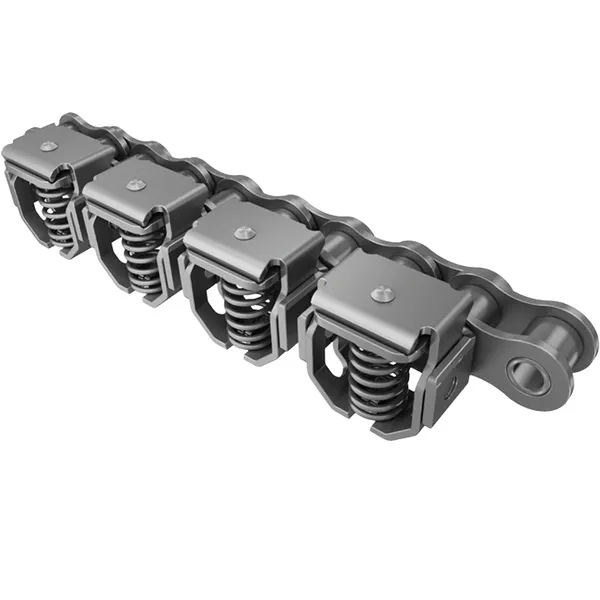
Bush roller chain(used in horizontal scraper conveyor)
1.Chains adopt high quality medium-carbon alloy steel, chain plate material is 40Mn, pin and roller material is 40Cr. High quality material and good heat treatment guarantee excellent anti-shearing force and tensile strength during working and have good looking.
2.Model: GLF For TGSS flat scraper conveyor, install flat scrapper
General & Dimension(Material: Carbon Steel, Stainless Steel)
| Tipo |
Pitch P mm |
between inner plates b1 mm |
Bush Diameter d mm |
Pin Diameter d1 mm |
Bush Diameter d2 mm |
Plate Width H mm |
Plate Thickness T mm |
Flight Attachment (mm) | Rated Strength KN |
|||
| Width L |
Distance L1 |
Distance L2 |
diameter D |
|||||||||
| GLF66.5(5-6)D
|
66.5
|
26.5
|
22.23
|
12.7
|
16.23
|
30
|
5/6
|
160 | 102 | / | 2-Φ9X14 | 140
|
| 230 | 95 | 195 | 4-Φ9X14 |
|||||||||
| 270 | 102 | 228 | ||||||||||
| GLF66.675(5-6)D
|
66.675
|
26.5
|
22.23
|
12.7
|
16.23
|
30
|
5/6
|
182 | 90 | 150 | 4-Φ9X14
|
140
|
| 215 | 95 | 195 | ||||||||||
| 295 | 95 | 195 | ||||||||||
| GLF100(6)
|
100
|
38.5
|
36.0
|
16.0
|
21.6
|
40
|
6
|
170 | 115 | 2-Φ9X14 | 180
|
|
| 225 | 95 | 195 | 4-Φ9X14
|
|||||||||
| 294 | 115 | 245 | ||||||||||
| 370 | 155 | 255 | ||||||||||
| GLF125(6)D |
125 |
32.5 |
25.0 |
18.0 |
20.00 |
50 |
6 |
300 | 115 | 245 | 4-Φ9X14 |
200 |
| 370 | 130 | 330 | ||||||||||
| GLF160(8)D×385 | 160 | 36.5 | 36.0 | 17.8 | 24.50 | 50 | 8 | 385 | 130 | 330 | 4-Φ11X15 | 220 |
| GLF200(8)D×467 | 200 | 42.5 | 40.0 | 20.0 | 30.00 | 60 | 8 | 467 | 160 | 420 | 4-Φ13X17 | 250 |
| 81X | 66.27
|
26.99
|
23.02
|
11.1
|
16.23
|
28.6 | 4 | Welding attached plate, length and hole size customized Wood transport chain according to customer requirements
|
107 | |||
| 81XH | 31.4 |
6/8 | 152 | |||||||||
| 81XHH | 8 | 191 | ||||||||||
NOTE: Other specifications which are not listed above can be made to customers’ specifications.
Bush roller chain(used in U type scraper conveyor)
Model: GLR For TGSU arc scraper conveyor, install U type scrapper
General & Dimension(Material: Carbon Steel, Stainless Steel)
| Tipo | Pitch P mm |
between inner plates b1 mm |
Bush Diameter D mm |
Pin Diameter d1 mm |
Bush Diameter d2 mm |
Plate Width H mm |
Plate Thickness T mm |
Flight Attachment (mm) | Rated Strength KN |
|||
| Width L mm |
Distance L1mm |
Distance L2mm |
diameter D mm |
|||||||||
| GLR68(5) | 68 | 25.3 | 22.23 | 11.1 | 16.23 | 29 | 5 | 102 | 32 | 4-Φ9 | 140 | |
| GLR60(6)D | 60 | 26.0 | 22.23 | 12.7 | 30 | 6 | 130 | 100 | 32 | 4-Φ9 | 140 | |
| GLR66.5(6)D | 66.5 | 26.5 | 22.23 | 12.7 | 16.23 | 30 | 6 | 130 | 102 | 32 | 4-Φ9 | 140 |
| GLR80(6)D | 80 | 32.0 | 28.00 | 18.0 | 42 | 6 | 160 | 120 | 32 | 4-Φ9 | 140 | |
| GLR100(6)D | 100 | 38.5 | 36.00 | 16.0 | 21.6 | 40 | 6 | 130 | 102 | 32 | 4-Φ9 | 180 |
Ring Chain
| DRAG CONVEYOR Tipo |
Ring Chain Tipo |
Pitch P(mm) |
Diameter d(mm) |
length L1(mm) |
Width W(mm) |
Flight Tipo |
Wing Width L(mm) |
Flight Width H(mm) |
| GSS16 | D10-55-13 | 55 | 10 | 74 | 32.5 | HF16 | 148 | 43.5 |
| GSS20 | D10-55-13 | 55 | 10 | 74 | 32.5 | HF20 | 188 | 43.5 |
| GSS25 | D10-55-13 | 55 | 10 | 74 | 32.5 | HF25 | 225 | 43.5 |
| GSS32 | D14-70-18 | 70 | 14 | 95 | 45 | HF32 | 300 | 54.5 |
| GSS40 | D14-70-18 | 70 | 14 | 95 | 45 | HF40 | 382 | 54.5 |
Offset Sidebar Chain
| Tipo | Pitch P mm |
Bush Diameter d1 |
Pin Diameter d |
Plate Width H |
Width between plates at inner ends b1 |
Width between plates at outer ends b2 |
Plate Thickness T1 |
Rated Strength KN |
Wing Plate Thickness T2 |
Wing Width L mm |
| WH78 | 66.27 | 22.23 | 12.7 | 28.4 | 28.4 | 51 | 6.4 | 93.4 | Welding attached plate, length and hole size customized | |
| WH82 | 78.1 | 27 | 14.29 | 32 | 44 | 57 | 6.4 | 132 | ||
| WH124 | 101.6 | 36.5 | 19.05 | 38.1 | 41.3 | 70 | 9.5 | 300 | ||
| WH132 | 153.67 | 44.45 | 25.25 | 50.8 | 77.1 | 111.76 | 12.7 | 378 | ||
| WH150 | 153.67 | 44.45 | 25.25 | 63.5 | 77.1 | 111.76 | 12.7 | 398 | ||
| WH155 | 153.67 | 44.45 | 28.42 | 63.5 | 73.6 | 111.25 | 14.27 | 411 | ||
| WH157 | 153.67 | 44.45 | 28.42 | 63.5 | 76.4 | 117.35 | 15.88 | 552 | ||
Forged Chain
| Pitch P(mm) |
Pin Diameter d(mm) |
Plate Width H(mm) |
b1 (mm) |
b2 (mm) |
b3 (mm) |
T1 (mm) |
T2 (mm) |
Wing Width L(mm) |
Rated Strength |
| 100 | 14 | 30 | 15 | 33 | 16 | 13 | 6(8) | Welding attached plate, length and hole size customized | 140 kN |
| 125 | 17 | 35 | 17 | 34 | 18 | 8 | 6(8) | 150KN | |
| 142 | 25.4 | 50.8 | 19 | 43 | 20 | 12.2 | 8(10) | 270KN | |
| 142(H) | 25.4 | 50.8 | 29 | 62 | 30 | 15 | 8(10) | 340KN | |
| 150 | 18 | 40 | 18 | 40 | 20 | 11.5 | 6(8.10) | 200KN | |
| 200 | 21 | 45 | 20 | 42 | 22 | 12.2 | 6(8.10) | 270KN |
perfil de companhia
ZheJiang CZPT CONVEYING EQUIPMENT CO. LTD., Established in 2011, specializing in bucket elevator, conveyor parts manufacturing, in recent years, more than 10 research and development of food conveying accessories obtained national invention and edible new patents.
Our factory is located in Daoshu Industrial Park, HangZhou City, ZheJiang Province, which is 1 of the most developed industrial areas in China. The company covers 28,000 square CZPT with the floor area of 8,000 square meters.
Our main products include elevator bucket, drag conveyor flight, UHMW-PE sheet, PVC elevator belts, elevator bolts, belt fastener, conveyor chains and more than 4 hundred types components which are widely used in bulk material handling and storage industry.
JINGWEI currently has more than 10 units of the whole series of 250-2500g injection molding machines, 1 production line of UHMW-PE sheet which is the higher pressure per unit in China, 1 special production line for PVC CZPT woven belt, 1 production line of elevator bolts and nut, 1 production line for conveyor chains. We annually produce 5 million plastic elevator buckets, 2 million steel buckets, 500 tons of UHMW-PE products, 0.8 million square CZPT of PVC CZPT woven elevator belt, 15 billion sets of elevator bolts, and 60,000 CZPT of conveyor chains.
Our company strictly in accordance with ISO9001 Quality Management System, and has obtained SGS certification. In order to raising working efficiency and reducing the cost of production, our company makes full use of computer network and ERP system to reform integration management in enterprise resource management, on the base of that, we have the ability to provide high quality products with competitive price and best service to customers.
JINGWEI believes the enterprise spirit of “integrity, pragmatic and innovative.” We will strive to become 1 of the best one-stop suppliers in the industry.
| Material: | Steel/Satinless Steel |
|---|---|
| Estrutura: | Corrente transportadora |
| Tratamento de superfície: | Shot Peening |
| Tamanho da corrente: | Glf/Glr |
| Recurso: | Resistente ao fogo, resistente a óleo, resistente ao calor. |
| Função: | transmission |
| Exemplos: |
US$ 20/Piece
1 unidade (pedido mínimo) | |
|---|
| Personalização: |
Disponível
| Solicitação personalizada |
|---|

Quais são as considerações a serem feitas na seleção de uma corrente transportadora resistente à corrosão?
Ao selecionar uma corrente transportadora resistente à corrosão, vários fatores precisam ser considerados para garantir a longevidade e o desempenho da corrente em ambientes corrosivos. Aqui estão algumas considerações importantes:
1. Seleção do Material: Escolha um material para a corrente que seja inerentemente resistente à corrosão. O aço inoxidável, como o AISI 304 ou o AISI 316, é uma escolha comum devido às suas excelentes propriedades de resistência à corrosão. Outros materiais, como correntes de plástico ou ligas especiais, também podem ser considerados, dependendo dos requisitos específicos da aplicação.
2. Revestimentos e Tratamentos de Superfície: Em alguns casos, revestimentos protetores adicionais ou tratamentos de superfície podem ser aplicados para aumentar a resistência à corrosão da corrente. Esses revestimentos, como zincagem, galvanização ou revestimentos epóxi, criam uma barreira entre o material da corrente e as substâncias corrosivas, impedindo o contato direto e reduzindo o risco de corrosão.
3. Compatibilidade Ambiental: Considere os agentes corrosivos específicos presentes no ambiente onde a corrente transportadora será utilizada. Diferentes substâncias corrosivas, como ácidos, álcalis ou água salgada, exigem propriedades de resistência específicas. Certifique-se de que o material e os revestimentos selecionados para a corrente sejam compatíveis com os agentes corrosivos presentes no ambiente operacional.
4. Manutenção e Lubrificação: A manutenção e a lubrificação adequadas desempenham um papel crucial na prevenção da corrosão e no prolongamento da vida útil de uma corrente transportadora. A limpeza, a inspeção e a aplicação regulares de lubrificantes apropriados podem ajudar a remover contaminantes corrosivos e proteger a superfície da corrente contra a degradação.
5. Testes e Certificação: Considere correntes que tenham sido submetidas a testes e certificação de resistência à corrosão de acordo com as normas relevantes do setor. Procure por certificações como ISO 9227 (teste de névoa salina) ou ASTM B117 (teste de resistência à corrosão) para garantir o desempenho da corrente em ambientes corrosivos.
Ao considerar cuidadosamente esses fatores e consultar fabricantes de correntes transportadoras ou especialistas em resistência à corrosão, você pode selecionar uma corrente adequada ao seu ambiente corrosivo específico, minimizando o risco de problemas relacionados à corrosão e garantindo desempenho e durabilidade ideais.
Quais são as melhores práticas para armazenar e manusear correntes transportadoras?
O armazenamento e manuseio adequados das correntes transportadoras são essenciais para manter seu desempenho, evitar danos e prolongar sua vida útil. Aqui estão algumas boas práticas a serem consideradas:
1. Área de armazenamento limpa e seca: Armazene as correntes transportadoras em um ambiente limpo e seco para evitar o acúmulo de sujeira, poeira, umidade ou contaminantes que possam afetar seu desempenho e causar corrosão.
2. Suporte adequado: Certifique-se de que as correntes transportadoras armazenadas estejam devidamente apoiadas para evitar curvaturas ou deformações excessivas. Utilize paletes, racks ou contêineres de armazenamento apropriados que suportem o peso e o comprimento das correntes.
3. Evite calor ou frio excessivos: As correntes transportadoras devem ser armazenadas em uma área com temperatura moderada para evitar calor ou frio extremos que possam afetar as propriedades do material ou a lubrificação das correntes.
4. Proteção contra impactos e vibrações: Proteja as correntes armazenadas contra impactos ou vibrações excessivas que possam causar danos ou deformações. Utilize embalagens ou capas adequadas para proteger as correntes de possíveis danos físicos.
5. Lubrificação: Aplique uma fina camada de lubrificante apropriado nas correntes antes do armazenamento para evitar corrosão e manter seu bom funcionamento. Siga as recomendações do fabricante quanto ao tipo e quantidade de lubrificante.
6. Inspeções regulares: Inspecione periodicamente as correntes transportadoras armazenadas para garantir que não haja sinais de danos, corrosão ou deformação. Se algum problema for identificado, tome as medidas apropriadas, como limpeza, lubrificação ou substituição das correntes.
7. Técnicas adequadas de manuseio: Ao manusear correntes transportadoras, utilize equipamentos ou ferramentas de elevação apropriados para evitar tensão excessiva ou flexão. Evite arrastar ou deixar cair as correntes, pois isso pode danificar os elos ou acessórios da corrente.
8. Treinamento e conscientização: Ofereça treinamento aos funcionários envolvidos no manuseio e armazenamento de correntes transportadoras para garantir que compreendam os procedimentos adequados e as melhores práticas. Promova a conscientização sobre a importância do manuseio e armazenamento cuidadosos para evitar acidentes e manter a integridade da corrente.
Seguindo essas boas práticas, você pode garantir a longevidade e o desempenho confiável de suas correntes transportadoras, reduzindo o risco de paradas não programadas e reparos dispendiosos.

What are the advantages of using a conveyor chain in material handling?
Conveyor chains offer numerous advantages in material handling applications, making them a preferred choice in various industries. Here are some of the key advantages:
- Efficient Transportation: Conveyor chains provide a continuous and reliable means of transporting materials, ensuring a smooth flow throughout the production or distribution process. They can handle both light and heavy loads, enabling efficient movement of items of different sizes and weights.
- Increased Productivity: By automating the material handling process, conveyor chains help increase productivity and operational efficiency. They eliminate the need for manual handling and reduce human effort, allowing employees to focus on other tasks, resulting in higher throughput and reduced labor costs.
- Flexibility and Customization: Conveyor chains can be designed and configured to meet specific material handling requirements. They are available in various lengths, widths, and configurations, allowing for customization based on the layout and space constraints of the facility. Additionally, different types of conveyor chains can be selected to handle specific materials or accommodate special handling needs.
- Improved Safety: Conveyor chains enhance workplace safety by reducing the risk of manual lifting and carrying heavy loads. They provide a controlled and controlled movement of materials, minimizing the chances of accidents and injuries. Additionally, safety features such as emergency stop buttons, guardrails, and sensors can be incorporated into the conveyor system to further enhance safety.
- Space Optimization: Conveyor chains utilize vertical and horizontal space efficiently, making them ideal for facilities with limited floor space. They can be designed to navigate corners, inclines, and declines, allowing for optimized layout and maximizing the use of available space.
- Versatility: Conveyor chains are versatile and can handle a wide range of materials, including bulk items, packaged goods, fragile items, and irregularly shaped objects. They can accommodate different types of conveyance methods such as flat, inclined, or spiral conveyors, providing flexibility in material handling processes.
- Improved Inventory Control: Conveyor chains enable better inventory control by facilitating the smooth movement and tracking of materials. They can be integrated with barcode scanners, RFID technology, or other tracking systems to monitor the flow of goods and provide real-time information on inventory levels.
- Reduced Material Damage: Conveyor chains help minimize material damage during handling and transportation. They provide a stable and controlled movement, reducing the risk of items falling or getting damaged due to manual handling or rough transportation methods.
The advantages of using a conveyor chain in material handling include improved efficiency, productivity, safety, space utilization, and inventory control, leading to cost savings and enhanced overall operational performance.


editor by CX 2023-07-25