Bakery, Cooling & Food Transfer Belts: define the interface before the part number
Successful food-conveyor selection starts with the physical interface and the operating duty. A chain or belt that appears similar can differ in pitch, attachment height, carrying-surface geometry, edge construction or guide requirements. This page organizes the buyer-side checks so a replacement or OEM request can be assessed from measured information rather than appearance alone.
Use the relevant product family page for verified model dimensions, then return to this guide for application variables that are specific to the machine.
Inputs that should be written down
Record this factor as a measurable project input. Where the catalogue does not publish a performance rating, keep the operating condition in the RFQ for engineering review instead of converting it into an assumed limit.
Record this factor as a measurable project input. Where the catalogue does not publish a performance rating, keep the operating condition in the RFQ for engineering review instead of converting it into an assumed limit.
Record this factor as a measurable project input. Where the catalogue does not publish a performance rating, keep the operating condition in the RFQ for engineering review instead of converting it into an assumed limit.
Record this factor as a measurable project input. Where the catalogue does not publish a performance rating, keep the operating condition in the RFQ for engineering review instead of converting it into an assumed limit.
Build a geometry record that another engineer can reproduce
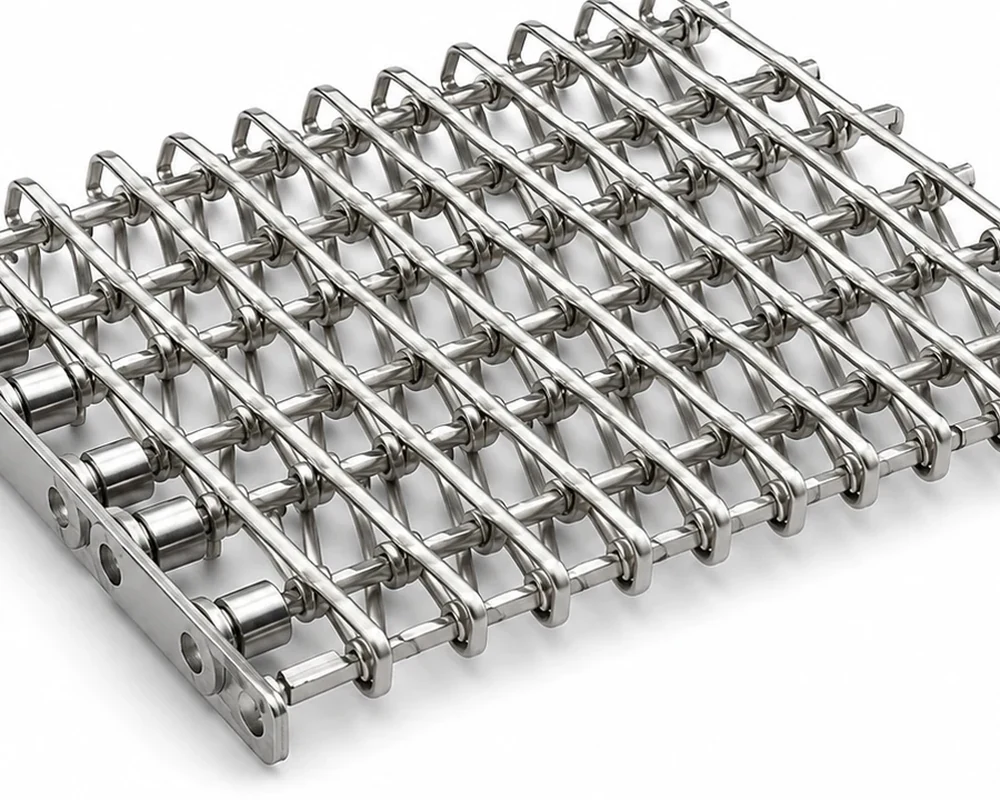
Measure pitch over several joints, not one. Record width in more than one location if the component is worn. For attachments, hooks, shells, blocks, wire spirals or side guards, measure both the individual feature and its repeating spacing. Photograph the drive interface with a scale reference. If the component is part of a parallel-chain system, include the center distance between chains and any cross-machine rods or fixtures.
| Input | What to record | Why it matters |
|---|---|---|
| Geometry | Pitch, width, roller/rod/wire sizes, attachment or mesh details | Establishes interchange dimensions |
| Drive | Sprocket or drive interface, tooth count where visible, shaft/guide photos | Prevents engagement mismatch |
| Duty | Speed, product load/spacing, starts, stops, curves and incline | Describes actual operating demand |
| Environment | Temperature zones, washdown, chemicals, contamination and drainage | Supports material and maintenance review |

Review the conveyor as a system
Guide rails, wear strips, support rollers, transfer plates, take-up range and cleaning access can create wear even when the chain or belt geometry is correct. When a failed component is being replaced, inspect the mating parts before assuming the component alone caused the problem. A recurring bright wear mark, bent attachment or stretched edge often points to a specific interference location.
The contact and RFQ page provides a concise submission checklist and the global enquiry form appears once in the footer.
What a production-ready RFQ should contain
- Controlled drawing or clearly marked photographs with reference dimensions.
- Exact model/designation when known and a note explaining any uncertainty.
- Required quantity, sample requirement and whether multiple models will be combined.
- Operating speed, product details, process temperature and sanitation method.
- Material or special-process requirement only when specified by the machine or project; otherwise request review rather than guessing.
- Mating sprocket/guide information and acceptance dimensions for incoming inspection.
Avoid three common procurement failures
These checks are simple to perform before an RFQ is released and they prevent many avoidable fit problems. Use them together rather than treating any one photograph or dimension as the complete acceptance basis.
Perspective hides pitch and width differences. Use photos to explain configuration, not as the sole dimensional record.
Distinguish a measured worn value from the intended nominal value. Measure multiple locations and compare to catalogue data.
A new chain on a damaged sprocket or guide can fail quickly. Inspect the complete interface during replacement planning.
Use wear patterns to refine the specification
Wear is useful evidence when it is tied to a location and a direction. Polish on one edge suggests lateral guidance or alignment. Repeating damage at a fixed pitch can indicate drive engagement, while a single damaged attachment may point to an impact or product jam. Before discarding the old component, mark the running direction and identify the section that operated near the drive, return, tightest curve or transfer. This information helps separate a product-selection issue from a machine-maintenance issue.
For conveyors that have been modified over time, create a current as-built record. Machine drawings may show the original geometry while replacement guides, wear strips or sprockets have changed the real interface. A simple dimensioned sketch of the current path can be more valuable than a historical part number. Keep the resulting drawing with the approved supplier configuration so future replacement work starts from controlled information.
Finally, plan inspection criteria before ordering production quantity. Decide which dimensions are critical to the machine, how they will be measured, and what visual features must be present. This makes incoming inspection objective and reduces the risk of accepting a visually similar part that cannot be installed. For food equipment, also document surface condition and cleaning expectations that affect handling and maintenance, without adding certification claims that have not been agreed for the order.
Turn the first successful run into a maintenance baseline
Once the selected component is installed, record the configuration that actually passed the machine check. Photograph the drive and a representative guide or transfer, note the running direction and document any take-up or support adjustment that was required. If the conveyor has several product formats, test the most demanding practical format rather than assuming that an empty run proves the complete application.
During the first scheduled inspection, compare the same locations. Look for new polish marks, product residue, edge contact, attachment movement or changes in reference length. A short repeatable record is more useful than a long narrative because it shows whether the condition is stable or changing. If a problem appears, the history helps determine whether the cause is product geometry, machine alignment, sanitation practice or the conveyor component itself.