
Produktbeschreibung
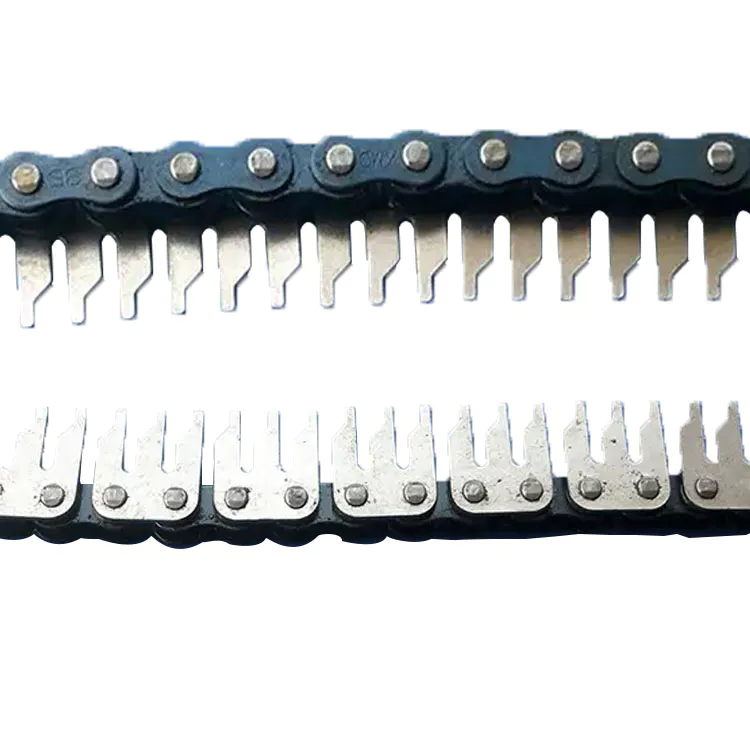
Small Roller Double Pitch Conveyor Chain for Industry Area
Produktbeschreibung
1. Material: Carbon Steel / Stainless Steel
2. Surface treatment: Shot Peening / Zinc-Plated / Nickel-Plated / Dacroment-Plated, etc
3. Application: Produced to ANSI B29.4, these chains are used in conveyor applications when loads are low and speeds are moderate. They are similar to the Double-Pitch Power Transmission Chains, but with link plates that have an oval contour, and can be produced with either standard or over-sized rollers. They are most often found working on conveyors of all shapes and sizes and can be supplied with 1 or more of our many attachments to carry or convey products.
| Product name | Small Roller Double Pitch Conveyor Chain for Industry Area |
| Materials Available | 1. Stainless Steel: SS304, SS316, etc |
| 2. Alloy Steel: 45Mn, 42CrMo, 20CrMo, etc | |
| 3. OEM according to your request | |
| Surface Treatment | Shot peening, Blackening, Oxygenation, Polishing, Zinc-plated, Nickel-plated, Anodized, etc. |
| Characteristic | Fire Resistant, Oil Resistant, Heat Resistant |
| Design criterion | ISO DIN ANSI & Customer’s Drawing |
| Größe | Customer’s Drawing & ISO standard |
| Package | Wooden Case / Container and pallet, or made-to-order |
| Certificate | ISO9001: 2008 |
| Advantage | First quality, Best service, Competitive price, Fast delivery |
| Delivery Time | 20 days for samples. 45 days for official order. |
Detailed Photos
View more products,please click here…
Company Profile
/* January 22, 2571 19:08:37 */!function(){function s(e,r){var a,o={};try{e&&e.split(“,”).forEach(function(e,t){e&&(a=e.match(/(.*?):(.*)$/))&&1
| Material: | Carbon Steel |
|---|---|
| Struktur: | Förderkette |
| Oberflächenbehandlung: | Ölblüte |
| Kettengröße: | C2040, C2050 |
| Besonderheit: | Hitzebeständig |
| Sample: | for Free |
| Proben: |
US$ 0/Meter
1 Meter(Min.Order) | |
|---|
| Anpassung: |
Verfügbar
| Kundenspezifische Anfrage |
|---|
Can a conveyor chain be used in automotive assembly lines?
Yes, a conveyor chain can be effectively used in automotive assembly lines. Here are the reasons why:
1. Efficient Material Handling:
– Conveyor chains provide a reliable and efficient means of transporting automotive components and parts along the assembly line. They can handle heavy loads and withstand the demanding requirements of automotive manufacturing.
2. Versatility:
– Conveyor chains offer versatility in terms of design and configuration. They can be customized to accommodate various assembly processes, such as body welding, painting, assembly, and final inspection.
3. Precise Positioning:
– Conveyor chains allow precise positioning and synchronization of automotive components, ensuring accurate assembly and alignment during the production process. This helps maintain consistent quality and reduces errors.
4. Automation Integration:
– Conveyor chains can be easily integrated with automation systems in automotive assembly lines. They can work in conjunction with robotic arms, vision systems, and other automated equipment to optimize the production process and improve efficiency.
5. Assembly Line Flexibility:
– Conveyor chains provide flexibility in terms of line configuration and layout. They can be designed to accommodate different assembly line layouts, including straight sections, curves, inclines, and declines, to meet the specific requirements of automotive assembly processes.
6. Space Optimization:
– Conveyor chains help optimize space utilization in automotive assembly plants. They can be designed to navigate around existing equipment and infrastructure, making efficient use of available floor space.
7. Safety:
– Conveyor chains are designed with safety features to protect operators and prevent accidents. Emergency stop controls, guarding, and interlocking mechanisms ensure the safe operation of the assembly line.
8. Increased Production Speed:
– By using conveyor chains, automotive assembly lines can achieve higher production speeds, allowing for faster manufacturing cycles and increased output.
Overall, conveyor chains play a crucial role in enhancing the efficiency, productivity, and safety of automotive assembly lines, contributing to the smooth and streamlined production of vehicles.

Welche Vorteile bietet die Verwendung einer Rollenförderkette?
Eine Rollenförderkette bietet zahlreiche Vorteile in Materialhandhabungs- und Transportanwendungen. Hier einige davon:
1. Effizienter Transport: Rollenförderketten sind für den reibungslosen und effizienten Transport verschiedenster Güter und Materialien konzipiert. Die Rollen sorgen für eine reibungsarme Bewegung und reduzieren so den Kraftaufwand beim Transport der Ladung entlang des Förderers.
2. Vielseitigkeit: Rollenförderketten sind vielseitig einsetzbar und eignen sich für eine breite Palette von Produkten, von kleinen und leichten Artikeln bis hin zu schweren und sperrigen Lasten. Sie werden häufig in Branchen wie Fertigung, Vertrieb, Logistik und Lagerhaltung eingesetzt.
3. Langlebigkeit: Rollenförderketten werden typischerweise aus robusten Materialien wie Stahl gefertigt, was ihnen eine ausgezeichnete Haltbarkeit und Langlebigkeit verleiht. Sie halten hohen Belastungen, wiederholter Nutzung und rauen Arbeitsumgebungen stand.
4. Flexibilität: Rollenförderketten lassen sich in verschiedenen Konfigurationen an unterschiedliche Platzanforderungen und Materialflussmuster anpassen. Sie können gerade, gebogen, geneigt oder abfallend verlaufen, um den Warenfluss innerhalb der Anlage zu optimieren.
5. Einfache Produktansammlung: Rollenförderketten ermöglichen eine effiziente Produktansammlung ohne Beschädigung oder Verstopfung. Die Rollen können mit spezifischen Abständen und Konfigurationen konstruiert werden, um eine kontrollierte Ansammlung und Abgabe von Artikeln entlang der Förderstrecke zu gewährleisten.
6. Minimaler Wartungsaufwand: Bei ordnungsgemäßer Wartung und Schmierung benötigen Rollenförderketten nur minimalen Wartungsaufwand. Die Konstruktion von Kette und Rollen reduziert die Ansammlung von Ablagerungen und erleichtert so die Reinigung und Wartung.
7. Laufruhiger und leiser Betrieb: Der Einsatz von Rollen in der Förderkette gewährleistet einen ruhigen und leisen Betrieb und reduziert so den Geräuschpegel am Arbeitsplatz. Dies schafft ein komfortableres und produktiveres Arbeitsumfeld.
8. Erhöhte Sicherheit: Rollenförderketten sind auf maximale Sicherheit ausgelegt. Sie können mit verschiedenen Sicherheitsmerkmalen wie Schutzvorrichtungen, Sensoren und Not-Aus-Mechanismen ausgestattet werden, um die Sicherheit der Bediener zu gewährleisten und Unfälle zu vermeiden.
Durch den Einsatz einer Rollenförderkette können Unternehmen von verbesserter Effizienz, erhöhter Haltbarkeit, Flexibilität beim Materialtransport und erhöhter Sicherheit in ihren Betriebsabläufen profitieren.
What is the load capacity of a conveyor chain?
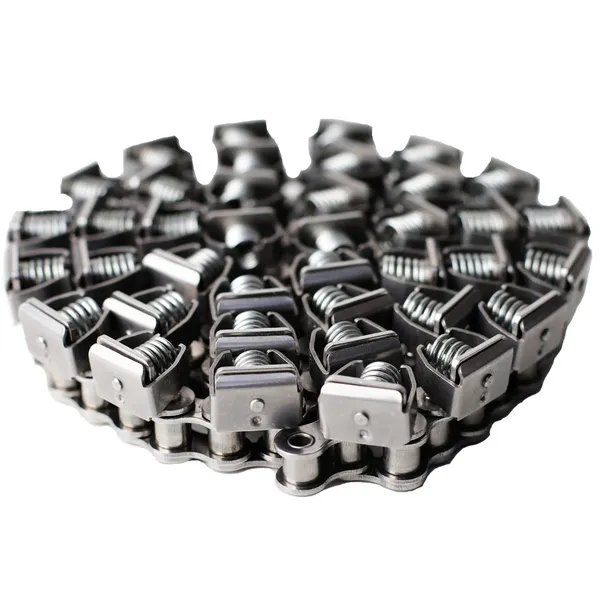
The load capacity of a conveyor chain depends on various factors, including the chain design, material, size, and the operating conditions. It is crucial to consider the specific application requirements when determining the load capacity of a conveyor chain. Here are some key factors to consider:
- Chain Design: Different types of conveyor chains have varying load capacities. The chain design includes factors such as the type of links, their configuration, and the presence of attachments or rollers.
- Material: The material used to manufacture the conveyor chain significantly affects its load capacity. Common materials include steel, stainless steel, and plastic. Steel chains are generally more robust and have higher load-bearing capabilities.
- Kettengröße: The size of the conveyor chain, including the pitch and width, plays a role in determining its load capacity. Larger chains with wider links tend to have higher load capacities.
- Operating Conditions: Factors such as the speed of the conveyor, the type and weight of the transported materials, and the environmental conditions (temperature, humidity, etc.) can impact the load capacity of the chain.
- Manufacturer Specifications: It is essential to consult the manufacturer’s specifications and guidelines for the specific conveyor chain being used. Manufacturers typically provide load capacity charts or tables based on their chain designs.
The load capacity of a conveyor chain is typically specified in terms of its maximum allowable working load or breaking strength. These values are determined through rigorous testing and engineering calculations. To ensure safe and efficient operation, it is important to select a conveyor chain that has a load capacity suitable for the intended application. Exceeding the recommended load capacity can lead to premature wear, chain failure, and potential safety hazards.


editor by CX 2024-04-17