
Description du produit
| Model NO. | 06C/08A/10A/12A/16A/20A/24A/28A/32A/40A/06B/08B/10B/12B/16B/20B/24B/28B/32B/40B-1/2/3 Heavy duty |
| Chain Model | Roller Chains |
| Structure (for Chain) | Chaîne à rouleaux |
| Spécification | GB/T, DIN, ANSI, ISO, BS, JIS. |
| Origine | HangZhou, ZheJiang |
| Couleur | Solid Color |
| Chain Color | Personnalisé |
From raw material carbon steel to the chain with your brand, send us your inquiry we will make it for you
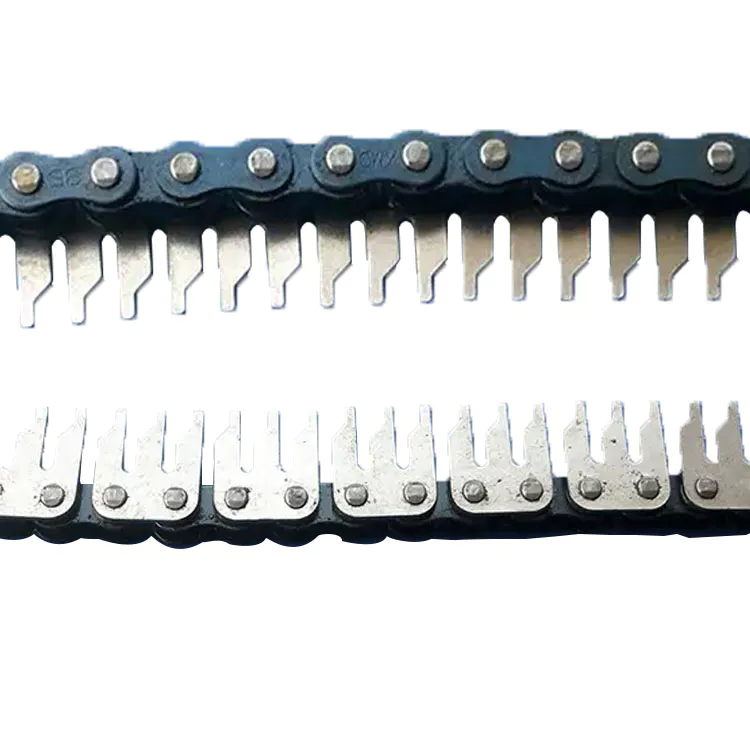
A/B series roller chain, agri chain with attachment, suitable for the corn harvester, wheat harvester~
we can make according to your sample or drawing~
Our company
Wolff Chain Co. is 1 of the professional chain manufacturers in China. We focus on reseaching, manufacturing and trading of the chain drive with famous brands — “DOVON” and “DECHO”. We supply OEM services for many famous enterprises such as SUZUKI, XIHU (WEST LAKE) DIS., FAW, AGCO, JUMING as well.
Wolff mainly producing the Transmission chains,Conveyor chains,Dragging Chains,Silent chains,Leaf chains,Roller chains,Special chain and many other series of chain products. Our technicians a have improved the chains quality to the world-level. High quality material selection, powerful and precise heat-treatment technology and excellent assembly methods ensure Wolff chains meet the tough and strict requirements for machines and vehicles.
All of our products completely conform to the international standard such as ISO\DIN\ANSI\BS\JIS, etc. Wolff has been successfully certified by ISO9001 Quality Management System,SGS inspection and BV inspection. Wolff chains can be widely applied to many industries including automobile, motorcycle, forklift, wood processing machine, constructure machine, packing machine, food machine,tobacco machine and agricultural equipments. Wolff chains are popular in America,South America,Europe,Middle East, South East Asia and Africa markets.
Our workshop
Our certification
Welcome to our exhibition
FAQ
Q1. What is your terms of packing?
A: Generally, we pack our goods in single color box. If you have special request about packing, pls negotiate with us in advance, we can pack the goods as your request.
Q2. What is your terms of payment?
A: T/T 30% as deposit, and 70% before delivery. We’ll show you the photos of the products and packages
before you pay the balance. Other payments terms, pls negotiate with us in advance, we can discuss.
Q3. What is your terms of delivery?
A: EXW, FOB, CFR, CIF.
Q4. How about your delivery time?
A: Generally, it will take 25 to 30 days after receiving your advance payment. The specific delivery time depends
on the items and the quantity of your order.
Q5. Can you produce according to the samples?
A: Yes, we can produce by your samples or technical drawings. We can build the molds and fixtures.
Q6. What is your sample policy?
A: We can supply the sample if we have ready parts in stock, but the customers have to pay the sample cost and
the courier cost.We welcome sample order.
Q7. Do you test all your goods before delivery?
A: Yes, we have 100% test before delivery
Q8: How do you make our business long-term and good relationship?
1. We keep good quality and competitive price to ensure our customers benefit ;
2. We respect every customer as our friend and we sincerely do business and make friends with them,
no matter where they come from.
| Standard ou non standard : | Standard |
|---|---|
| Application: | Textile Machinery, Garment Machinery, Conveyer Equipment, Packaging Machinery, Food Machinery, Marine, Mining Equipment |
| Traitement de surface : | Oil Blooming |
| Structure: | Chaîne à rouleaux |
| Matériel: | Carbon Steel |
| Taper: | Short Pitch Chain |
| Exemples : |
US$ 0/Piece
1 pièce (commande minimale) | |
|---|
| Personnalisation : |
Disponible
| Demande personnalisée |
|---|
Can a conveyor chain be used in automotive assembly lines?
Yes, a conveyor chain can be effectively used in automotive assembly lines. Here are the reasons why:
1. Efficient Material Handling:
– Conveyor chains provide a reliable and efficient means of transporting automotive components and parts along the assembly line. They can handle heavy loads and withstand the demanding requirements of automotive manufacturing.
2. Versatility:
– Conveyor chains offer versatility in terms of design and configuration. They can be customized to accommodate various assembly processes, such as body welding, painting, assembly, and final inspection.
3. Precise Positioning:
– Conveyor chains allow precise positioning and synchronization of automotive components, ensuring accurate assembly and alignment during the production process. This helps maintain consistent quality and reduces errors.
4. Automation Integration:
– Conveyor chains can be easily integrated with automation systems in automotive assembly lines. They can work in conjunction with robotic arms, vision systems, and other automated equipment to optimize the production process and improve efficiency.
5. Assembly Line Flexibility:
– Conveyor chains provide flexibility in terms of line configuration and layout. They can be designed to accommodate different assembly line layouts, including straight sections, curves, inclines, and declines, to meet the specific requirements of automotive assembly processes.
6. Space Optimization:
– Conveyor chains help optimize space utilization in automotive assembly plants. They can be designed to navigate around existing equipment and infrastructure, making efficient use of available floor space.
7. Safety:
– Conveyor chains are designed with safety features to protect operators and prevent accidents. Emergency stop controls, guarding, and interlocking mechanisms ensure the safe operation of the assembly line.
8. Increased Production Speed:
– By using conveyor chains, automotive assembly lines can achieve higher production speeds, allowing for faster manufacturing cycles and increased output.
Overall, conveyor chains play a crucial role in enhancing the efficiency, productivity, and safety of automotive assembly lines, contributing to the smooth and streamlined production of vehicles.
Quelles sont les tendances et les avancées futures en matière de technologie des chaînes de convoyage ?
Le secteur des technologies de convoyage par chaînes est en constante évolution, sous l'impulsion d'un besoin accru d'efficacité, de productivité et de durabilité. Voici quelques-unes des tendances et avancées futures dans ce domaine :
1. Automatisation et robotique : L’intégration des chaînes de convoyage aux systèmes d’automatisation et de robotique est une tendance croissante. Elle comprend l’utilisation de capteurs avancés, de la vision industrielle et de l’intelligence artificielle pour permettre un fonctionnement autonome, un positionnement précis et une manutention efficace des matériaux.
2. Systèmes intelligents et connectés : Les chaînes de convoyeurs sont de plus en plus connectées grâce à l’Internet des objets (IoT). Cela permet la surveillance en temps réel, la collecte de données et l’analyse de divers paramètres de performance tels que l’usure de la chaîne, la tension, la température et la consommation d’énergie. Les systèmes intelligents peuvent optimiser les calendriers de maintenance, détecter les pannes potentielles et améliorer l’efficacité globale du système.
3. Matériaux légers et à haute résistance : Le développement de matériaux à la fois légers et à haute résistance est un axe de recherche constant dans le domaine des chaînes de convoyage. Les alliages de pointe, les composites et les plastiques techniques offrent des rapports résistance/poids améliorés, ce qui permet de réduire la consommation d’énergie et d’augmenter la capacité de charge des systèmes de convoyage.
4. Efficacité énergétique : L’efficacité énergétique est un critère essentiel dans la conception des chaînes de convoyage. Les progrès futurs visent à minimiser la consommation d’énergie grâce à l’utilisation de systèmes d’entraînement performants, du freinage régénératif et d’algorithmes de contrôle intelligents optimisant les profils de vitesse et d’accélération. Les technologies de récupération d’énergie, telles que les entraînements régénératifs, permettent également de capter et de réutiliser l’énergie lors de la décélération ou du freinage.
5. Durabilité et respect de l'environnement : La technologie des chaînes de convoyage évolue vers des solutions plus durables et respectueuses de l'environnement. Cela inclut l'utilisation de matériaux écologiques, des techniques de lubrification améliorées pour minimiser l'impact environnemental et l'adoption de composants et de systèmes économes en énergie. Les concepts de recyclage et d'économie circulaire prennent également une place de plus en plus importante dans la conception et la fabrication des chaînes de convoyage.
6. Surveillance avancée de l'usure et maintenance prédictive : L'avenir des chaînes de convoyeurs repose sur des systèmes de surveillance de l'usure avancés, capables de prédire avec précision la durée de vie restante des chaînes et de leurs composants. Ceci permet une planification proactive de la maintenance et réduit les temps d'arrêt imprévus. Les algorithmes de maintenance prédictive analysent les données collectées par les capteurs et émettent des alertes en temps opportun pour le remplacement ou la réparation des chaînes.
Ce ne sont là que quelques exemples des tendances et avancées futures en matière de technologies de chaînes de convoyage. Avec les progrès technologiques constants, nous pouvons nous attendre à de nouvelles innovations qui amélioreront la performance, l'efficacité, la fiabilité et la durabilité des systèmes de convoyage.
What are the industry standards and regulations for conveyor chains?
In the field of conveyor chains, there are several industry standards and regulations that help ensure safety, performance, and quality. Some of the commonly recognized standards include:
1. ISO 1977:2013 – Conveyor chains, attachments, and sprockets: This International Organization for Standardization (ISO) standard specifies the requirements and dimensions for various types of conveyor chains, attachments, and sprockets used in general industrial applications.
2. ANSI/ASME B29.1 – Precision Power Transmission Roller Chains, Attachments, and Sprockets: This American National Standard Institute (ANSI) standard provides guidelines for the design, dimensions, and performance of roller chains, attachments, and sprockets used in power transmission systems, including conveyor chains.
3. CEMA – Conveyor Equipment Manufacturers Association: CEMA publishes various standards and technical documents related to conveyor systems, including conveyor chains. These standards cover topics such as safety, design, installation, maintenance, and operation of conveyor equipment.
4. OSHA – Occupational Safety and Health Administration: OSHA is a regulatory agency in the United States that sets and enforces safety standards for workplaces. They have specific regulations related to conveyor systems, including requirements for guarding, maintenance, and employee safety.
5. Local and National Building Codes: Depending on the location and application, there may be specific building codes or regulations that dictate the design, installation, and operation of conveyor chains. These codes ensure compliance with safety and structural requirements.
It’s important for conveyor chain manufacturers, system integrators, and end-users to adhere to these industry standards and regulations to ensure the safe and reliable operation of conveyor systems. Compliance with these standards helps to maintain worker safety, promote system performance, and ensure compatibility and interchangeability of conveyor chain components.


editor by CX 2023-11-20