
Descrição do produto
| Model NO. | 06C/08A/10A/12A/16A/20A/24A/28A/32A/40A/06B/08B/10B/12B/16B/20B/24B/28B/32B/40B-1/2/3 Heavy duty |
| Chain Model | Roller Chains |
| Structure (for Chain) | Corrente de rolos |
| Especificação | GB/T, RUÍDO, ANSI, ISO, BS, JIS. |
| Origin | HangZhou, ZheJiang |
| Cor | Solid Color |
| Chain Color | Personalizado |
From raw material carbon steel to the chain with your brand, send us your inquiry we will make it for you
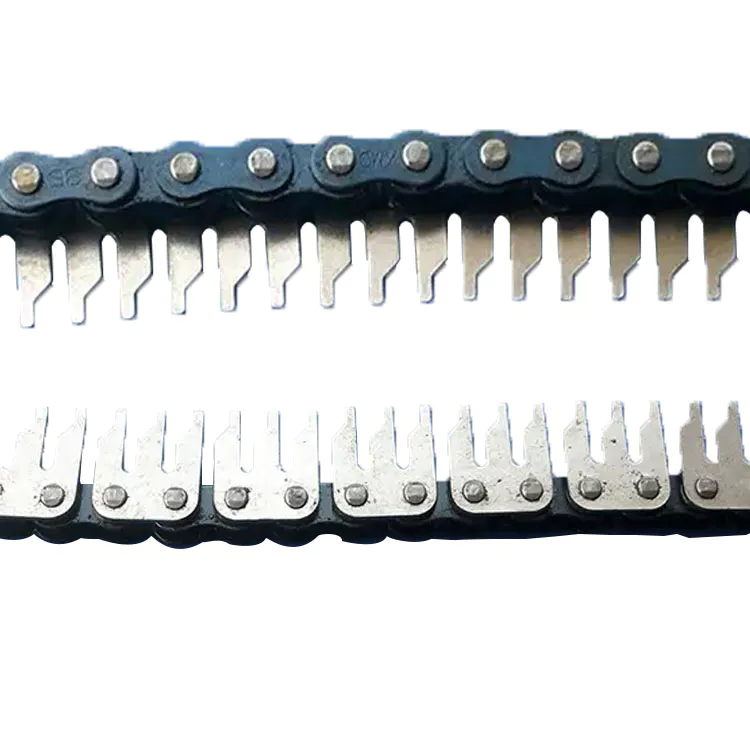
A/B series roller chain, agri chain with attachment, suitable for the corn harvester, wheat harvester~
we can make according to your sample or drawing~
Our company
Wolff Chain Co. is 1 of the professional chain manufacturers in China. We focus on reseaching, manufacturing and trading of the chain drive with famous brands — “DOVON” and “DECHO”. We supply OEM services for many famous enterprises such as SUZUKI, XIHU (WEST LAKE) DIS., FAW, AGCO, JUMING as well.
Wolff mainly producing the Transmission chains,Conveyor chains,Dragging Chains,Silent chains,Leaf chains,Roller chains,Special chain and many other series of chain products. Our technicians a have improved the chains quality to the world-level. High quality material selection, powerful and precise heat-treatment technology and excellent assembly methods ensure Wolff chains meet the tough and strict requirements for machines and vehicles.
All of our products completely conform to the international standard such as ISO\DIN\ANSI\BS\JIS, etc. Wolff has been successfully certified by ISO9001 Quality Management System,SGS inspection and BV inspection. Wolff chains can be widely applied to many industries including automobile, motorcycle, forklift, wood processing machine, constructure machine, packing machine, food machine,tobacco machine and agricultural equipments. Wolff chains are popular in America,South America,Europe,Middle East, South East Asia and Africa markets.
Our workshop
Our certification
Welcome to our exhibition
Perguntas frequentes
Q1. What is your terms of packing?
A: Generally, we pack our goods in single color box. If you have special request about packing, pls negotiate with us in advance, we can pack the goods as your request.
Q2. What is your terms of payment?
A: T/T 30% as deposit, and 70% before delivery. We’ll show you the photos of the products and packages
before you pay the balance. Other payments terms, pls negotiate with us in advance, we can discuss.
Q3. What is your terms of delivery?
A: EXW, FOB, CFR, CIF.
Q4. How about your delivery time?
A: Generally, it will take 25 to 30 days after receiving your advance payment. The specific delivery time depends
on the items and the quantity of your order.
Q5. Can you produce according to the samples?
A: Yes, we can produce by your samples or technical drawings. We can build the molds and fixtures.
Q6. What is your sample policy?
A: We can supply the sample if we have ready parts in stock, but the customers have to pay the sample cost and
the courier cost.We welcome sample order.
Q7. Do you test all your goods before delivery?
A: Yes, we have 100% test before delivery
Q8: How do you make our business long-term and good relationship?
1. We keep good quality and competitive price to ensure our customers benefit ;
2. We respect every customer as our friend and we sincerely do business and make friends with them,
no matter where they come from.
| Padrão ou não padrão: | Padrão |
|---|---|
| Aplicativo: | Textile Machinery, Garment Machinery, Conveyer Equipment, Packaging Machinery, Food Machinery, Marine, Mining Equipment |
| Tratamento de superfície: | Floração de óleo |
| Estrutura: | Corrente de rolos |
| Material: | Aço carbono |
| Tipo: | Corrente de passo curto |
| Exemplos: |
US$ 0/Peça
1 unidade (pedido mínimo) | |
|---|
| Personalização: |
Disponível
| Solicitação personalizada |
|---|
Can a conveyor chain be used in automotive assembly lines?
Yes, a conveyor chain can be effectively used in automotive assembly lines. Here are the reasons why:
1. Efficient Material Handling:
– Conveyor chains provide a reliable and efficient means of transporting automotive components and parts along the assembly line. They can handle heavy loads and withstand the demanding requirements of automotive manufacturing.
2. Versatility:
– Conveyor chains offer versatility in terms of design and configuration. They can be customized to accommodate various assembly processes, such as body welding, painting, assembly, and final inspection.
3. Precise Positioning:
– Conveyor chains allow precise positioning and synchronization of automotive components, ensuring accurate assembly and alignment during the production process. This helps maintain consistent quality and reduces errors.
4. Automation Integration:
– Conveyor chains can be easily integrated with automation systems in automotive assembly lines. They can work in conjunction with robotic arms, vision systems, and other automated equipment to optimize the production process and improve efficiency.
5. Assembly Line Flexibility:
– Conveyor chains provide flexibility in terms of line configuration and layout. They can be designed to accommodate different assembly line layouts, including straight sections, curves, inclines, and declines, to meet the specific requirements of automotive assembly processes.
6. Space Optimization:
– Conveyor chains help optimize space utilization in automotive assembly plants. They can be designed to navigate around existing equipment and infrastructure, making efficient use of available floor space.
7. Safety:
– Conveyor chains are designed with safety features to protect operators and prevent accidents. Emergency stop controls, guarding, and interlocking mechanisms ensure the safe operation of the assembly line.
8. Increased Production Speed:
– By using conveyor chains, automotive assembly lines can achieve higher production speeds, allowing for faster manufacturing cycles and increased output.
Overall, conveyor chains play a crucial role in enhancing the efficiency, productivity, and safety of automotive assembly lines, contributing to the smooth and streamlined production of vehicles.
Quais são as tendências e avanços futuros na tecnologia de correntes transportadoras?
O setor de tecnologia de correntes transportadoras está em constante evolução, impulsionado pela necessidade de maior eficiência, produtividade e sustentabilidade. A seguir, algumas das tendências e avanços futuros na tecnologia de correntes transportadoras:
1. Automação e robótica: A integração de esteiras transportadoras com sistemas de automação e robótica é uma tendência crescente. Isso inclui o uso de sensores avançados, visão computacional e inteligência artificial para permitir operação autônoma, posicionamento preciso e manuseio eficiente de materiais.
2. Sistemas inteligentes e conectados: As correntes transportadoras estão cada vez mais conectadas por meio da tecnologia da Internet das Coisas (IoT). Isso permite o monitoramento em tempo real, a coleta de dados e a análise de diversos parâmetros de desempenho, como desgaste da corrente, tensão, temperatura e consumo de energia. Os sistemas inteligentes podem otimizar os cronogramas de manutenção, detectar possíveis falhas e melhorar a eficiência geral do sistema.
3. Materiais leves e de alta resistência: O desenvolvimento de materiais leves, porém de alta resistência, é um foco constante na tecnologia de correntes transportadoras. Ligas avançadas, compósitos e plásticos de engenharia oferecem melhores relações resistência/peso, reduzindo o consumo de energia e aumentando a capacidade de carga dos sistemas de transporte.
4. Eficiência energética: A eficiência energética é uma consideração fundamental no projeto de correntes transportadoras. Os avanços futuros visam minimizar o consumo de energia por meio do uso de sistemas de acionamento eficientes, frenagem regenerativa e algoritmos de controle inteligentes que otimizam os perfis de velocidade e aceleração. Tecnologias de recuperação de energia, como acionamentos regenerativos, também podem capturar e reutilizar energia durante a desaceleração ou frenagem.
5. Sustentabilidade e respeito ao meio ambiente: A tecnologia de correntes transportadoras está caminhando em direção a soluções mais sustentáveis e ecológicas. Isso inclui o uso de materiais ecologicamente corretos, técnicas de lubrificação aprimoradas para minimizar o impacto ambiental e a adoção de componentes e sistemas energeticamente eficientes. Os conceitos de reciclagem e economia circular também estão ganhando destaque no projeto e na fabricação de correntes transportadoras.
6. Monitoramento avançado de desgaste e manutenção preditiva: O futuro da tecnologia de correntes transportadoras envolve sistemas avançados de monitoramento de desgaste que podem prever com precisão a vida útil restante das correntes e componentes. Isso permite o planejamento proativo da manutenção e reduz o tempo de inatividade não planejado. Algoritmos de manutenção preditiva analisam os dados coletados pelos sensores e fornecem alertas oportunos para a substituição ou reparo da corrente.
Esses são apenas alguns exemplos das tendências e avanços futuros na tecnologia de correntes transportadoras. À medida que a tecnologia continua a evoluir, podemos esperar mais inovações que aprimorem o desempenho, a eficiência, a confiabilidade e a sustentabilidade dos sistemas de transporte.
What are the industry standards and regulations for conveyor chains?
In the field of conveyor chains, there are several industry standards and regulations that help ensure safety, performance, and quality. Some of the commonly recognized standards include:
1. ISO 1977:2013 – Conveyor chains, attachments, and sprockets: This International Organization for Standardization (ISO) standard specifies the requirements and dimensions for various types of conveyor chains, attachments, and sprockets used in general industrial applications.
2. ANSI/ASME B29.1 – Precision Power Transmission Roller Chains, Attachments, and Sprockets: This American National Standard Institute (ANSI) standard provides guidelines for the design, dimensions, and performance of roller chains, attachments, and sprockets used in power transmission systems, including conveyor chains.
3. CEMA – Conveyor Equipment Manufacturers Association: CEMA publishes various standards and technical documents related to conveyor systems, including conveyor chains. These standards cover topics such as safety, design, installation, maintenance, and operation of conveyor equipment.
4. OSHA – Occupational Safety and Health Administration: OSHA is a regulatory agency in the United States that sets and enforces safety standards for workplaces. They have specific regulations related to conveyor systems, including requirements for guarding, maintenance, and employee safety.
5. Local and National Building Codes: Depending on the location and application, there may be specific building codes or regulations that dictate the design, installation, and operation of conveyor chains. These codes ensure compliance with safety and structural requirements.
It’s important for conveyor chain manufacturers, system integrators, and end-users to adhere to these industry standards and regulations to ensure the safe and reliable operation of conveyor systems. Compliance with these standards helps to maintain worker safety, promote system performance, and ensure compatibility and interchangeability of conveyor chain components.


editor by CX 2023-11-20