
Deskripsi Produk
Deskripsi Produk
Hollow pin chain, cast fixed pin chain, pintle chain, drop forged link chain and Engineer Class Driving Chain, with alloy steel and stainless steel selection according to your requirement
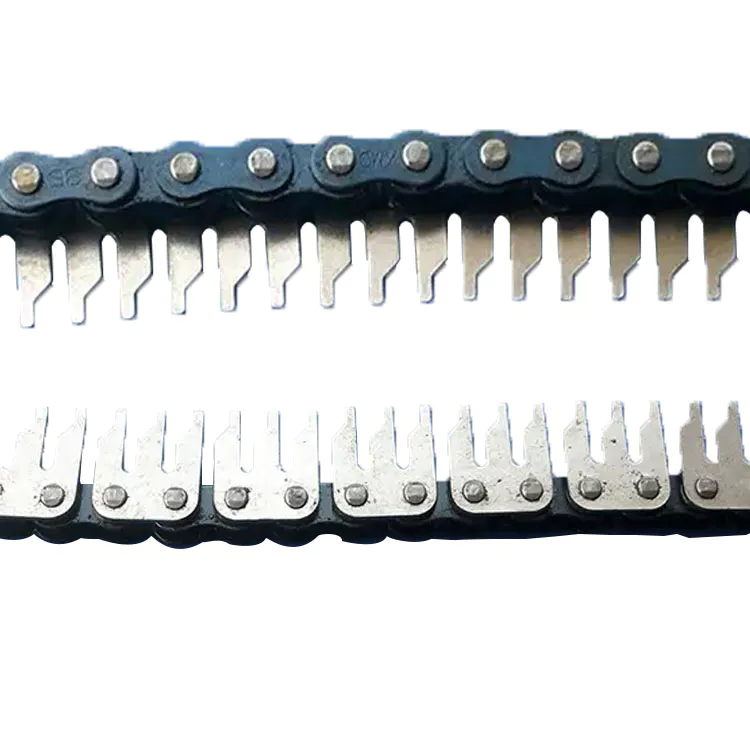
1. Jenis-jenis rantai: rantai tempa tanpa paku keling, rantai rol, rantai konveyor, rantai pertanian, rantai industri gula, rantai industri kelapa sawit, rantai industri aspal, rantai industri konveyor elevator, rantai fleksibel ganda, rantai pintle, rantai seret baja las, rantai lunak, dll;
2. Bahan utama: Baja paduan 40Mn, 40Cr, 45Mn atau SUS304 untuk pelat, 10#, 20#, 20CrMnMo, 30CrMnTi untuk pin dan rol;
3. Perlakuan panas: Karburisasi, pengerasan dengan austemper, pengerasan nitro-karburisasi, dll;
4. Permukaan: Shot peening, hitam, biru, atau asli;
5. Cara pengemasan: Kantong plastik + kotak karton + peti kayu lapis
Foto Detail
| ISO | ANSI | ||||||||||||
| Melempar | Diameter rol | Diameter rol | Width between inner plates | Diameter pin | Chain path depth | Plate depth | Maximum width over bearing pin | Connecting pin length | Minimum cranked link dimensions | Ultimate tensile strength | Berat per meter | ||
| p | d1(max) | d7(max) | b1(min) | d2(max) | h1(min) | h2(max) | b4 (max) | bs(max) | L1(min) | Q(min) | q≈ | ||
| mm | mm | mm | mm | mm | mm | mm | mm | mm | kN | kg/m | |||
| 208A | A2040 | 25.4 | 7.95 | 15.88 | 7.85 | 3.98 | 12.33 | 12.07 | 17.8 | 21.7 | 6.9 | 13.8 | 0.42 |
| 208B | 8.51 | 7.75 | 4.45 | 12.07 | 11.81 | 17 | 20.9 | 17.8 | 0.45 | ||||
| 210A | A2050 | 31.75 | 10.16 | 19.05 | 9.4 | 5.09 | 15.35 | 15.09 | 21.8 | 25.9 | 8.4 | 21.8 | 0.73 |
| 210B | 10.16 | 9.65 | 5.08 | 14.99 | 14.73 | 19.6 | 23.7 | 22.2 | 0.63 | ||||
| 212A | A2060 | 38.1 | 11.91 | 22.23 | 12.57 | 5.96 | 18.34 | 18.1 | 26.9 | 31.5 | 9.9 | 31.3 | 1.02 |
| 212B | 12.07 | 11.68 | 5.72 | 16.39 | 16.13 | 22.7 | 27.3 | 28.9 | 0.76 | ||||
| 216A | A2080 | 50.8 | 15.88 | 28.58 | 15.75 | 7.94 | 24.39 | 24.13 | 33.5 | 38.9 | 13 | 55.6 | 1.7 |
| 216B | 15.88 | 17.02 | 8.28 | 21.34 | 21.08 | 36.1 | 41.5 | 60 | 1.75 | ||||
| 220A | A2100 | 63.5 | 19.05 | 39.67 | 18.9 | 9.54 | 30.48 | 30.17 | 41.1 | 47.2 | 16 | 87 | 2.55 |
| 220B | 19.05 | 19.56 | 10.19 | 26.68 | 26.42 | 43.2 | 49.3 | 95 | 2.62 | ||||
| 224A | A2120 | 76.2 | 22.23 | 44.45 | 25.22 | 11.11 | 36.55 | 36.2 | 50.8 | 57.4 | 19.1 | 125 | 4.06 |
| 224B | 25.4 | 25.4 | 14.63 | 33.73 | 33.4 | 53.4 | 60 | 160 | 4.7 | ||||
| 228B | 88.9 | 27.94 | 30.99 | 15.9 | 37.46 | 37.08 | 65.1 | 72.5 | 21.3 | 200 | |||
| 232B | 101.6 | 29.21 | 30.99 | 17.81 | 42.72 | 42.29 | 67.4 | 75.3 | 24.4 | 250 | |||
| C208B | 25.4 | 8.51 | 15.88 | 7.75 | 4.45 | 12.07 | 11.81 | 17 | 20.9 | 6.9 | 17.8 | 0.55 | |
| C208BL | 4.45 | 0.89 | |||||||||||
| C208A | C2040 | 7.92 | 7.85 | 3.98 | 12.33 | 12.07 | 17.8 | 21.7 | 6.9 | 13.9 | 0.5 | ||
| C208AL | C2042 | 0.84 | |||||||||||
| C210A | C2050 | 31.75 | 10.16 | 19.05 | 9.4 | 5.09 | 15.35 | 15.09 | 21.8 | 25.9 | 8.4 | 21.8 | 0.78 |
| C210B | 5.08 | 14.99 | 14.73 | 22.2 | 0.78 | ||||||||
| C210AL | C2052 | 5.08 | 15.35 | 15.09 | 21.8 | 1.27 | |||||||
| C212A | C2060 | 38.1 | 11.91 | 22.23 | 12.57 | 5.96 | 18.34 | 18.1 | 26.9 | 31.5 | 9.9 | 31.3 | 1.12 |
| C212AH | C2062H | 1.44 | |||||||||||
| C212B | 38.1 | 12.07 | 22.23 | 11.68 | 5.72 | 16.39 | 16.13 | 22.7 | 9.9 | 28.9 | |||
| C216A | C2080 | 50.8 | 15.88 | 28.58 | 15.75 | 7.94 | 24.39 | 24.13 | 33.5 | 38.9 | 13 | 55.6 | 2.08 |
| C216AH | C2080H | 2.54 | |||||||||||
| C216B | 17.02 | 8.28 | 21.34 | 21.08 | 36.1 | 13 | 60 | ||||||
| C220A | C2100 | 63.5 | 19.05 | 19.05 | 18.9 | 9.54 | 30.48 | 30.17 | 41.1 | 47.2 | 16 | 87 | 3.01 |
| C220AH | C2102 | 39.67 | 3.6 | ||||||||||
| C220B | 63.5 | 39.67 | 19.56 | 10.19 | 26.68 | 26.42 | 43.2 | 16 | 95 | ||||
| C224A | C2120 | 76.2 | 22.23 | 44.45 | 25.22 | 11.11 | 36.55 | 36.2 | 50.8 | 57.4 | 19.1 | 125 | 4.66 |
| C224AH | C2122 | 5.26 | |||||||||||
| C224B | 25.4 | 25.4 | 14.63 | 33.73 | 33.4 | 53.4 | 19.1 | 160 | |||||
| C232AH | 101.6 | 28.58 | 57.15 | 31.55 | 14.29 | 48.74 | 48.26 | 69.4 | 25.2 | 222.4 | 9.06 | ||
Parameter Produk
Pengemasan & Pengiriman
1. Kemasan dalam: Kantong plastik, kantong gelembung udara, karton sesuai permintaan pembeli.
2. Kemasan luar: Kotak OSB atau palet.
3. Mohon ingat untuk mencantumkan informasi ALAMAT kontak yang benar untuk pengiriman.
Keunggulan Kami
Profil Perusahaan
Kami adalah produsen terkemuka suku cadang transmisi mekanik, serta pemasok yang andal dan tepercaya selama bertahun-tahun. Produk utama kami meliputi rantai rol, rantai konveyor, rantai pertanian, rantai industri gula, rantai industri kelapa sawit, rantai industri aspal, rantai industri konveyor elevator, dll.
Saat ini, untuk pasar Amerika Selatan, Eropa, dan Asia, produk unggulan kami diproduksi sesuai dengan kebutuhan Anda dan kualitas kami memenuhi standar ISO, ASME, dan DIN.
Silakan perhatikan langkah-langkah proses kami di bawah ini.
(1) melubangi pelat luar dan pelat dalamnya
(2)Bengkel shot peening
(3) bengkel perlakuan panas
(4) persiapan perakitan
(5) proses pin
(6) Uji Sifat Tarik sebelum pengiriman
Layanan Purna Jual
Produk kami dapat diperbaiki atau diganti dengan suku cadang baru secara gratis dalam waktu enam bulan.
Pertanyaan yang Sering Diajukan (FAQ)
Pertanyaan:
1. T: Bagaimana dengan biaya cetakan?
A: terutama bergantung pada: 1. Gambar, 2. Bahan, 3. Berat dan kuantitas.
Kita perlu mengetahui struktur setiap bagian untuk menganalisis solusi cetakan dengan cara:
1) –Gambar desain lengkap, model produk, atau sampel aktual —– cara terbaik
– Gambar PDF dengan dimensi lengkap untuk setiap bagian
–Foto yang jelas untuk setiap bagian dengan berbagai sudut pandang untuk menunjukkan setiap fitur.
2) Bahan, parameter teknis, dan perlakuan permukaan.
Parameter teknis: beri tahu kami tentang modelnya, jarak antar rol, diameter rol, lebar antar pelat bagian dalam, jenis pemasangan, gambar luar, dll.
3) Jumlah pesanan.
2. T: Bagaimana cara mengontrol proses produksi produk?
A: Laporan proses atau foto akan dikirimkan kepada pelanggan setiap minggu/bulan untuk ditinjau.
3. T: Siapa yang akan memiliki cetakan tersebut?
A:Pelanggan, cetakan juga dapat disimpan di pabrik kami untuk pesanan di masa mendatang.
4. T: Berapa lama waktu yang Anda butuhkan untuk membuat penawaran harga?
A:Setelah menerima informasi detail, kami akan memberikan penawaran harga dalam 1 hingga 3 hari.
5. T: Jumlah Pesanan Minimum (MOQ)? —
Jenis rantai kecil: jika jarak antar mata rantai kurang dari 38,10 mm dan ketebalannya kurang dari 5 mm, jumlah pesanan minimum (MOQ) adalah 1500 unit untuk rantai rol atau rantai konveyor ini (CHINAMFG);
tipe rantai tengah: jika jarak antar mata rantainya (38,10mm)
Jenis rantai besar: jika jarak antar mata rantai lebih dari 76,20 mm dan ketebalannya lebih dari 10 mm, jumlah pesanan minimum (MOQ) adalah 200 unit untuk rantai rol atau rantai konveyor buatan CHINAMFG;
Saya harap kita dapat berbisnis bersama, dan saya menantikan kabar dari CHINAMFG segera.
/* March 10, 2571 17:59:20 */!function(){function s(e,r){var a,o={};try{e&&e.split(“,”).forEach(function(e,t){e&&(a=e.match(/(.*?):(.*)$/))&&1
| Bahan: | Alloy Steel |
|---|---|
| Struktur: | Rantai Rol |
| Perlakuan Permukaan: | Shot Peening |
| Ukuran Rantai: | 8inch |
| Fitur: | Tahan Panas |
| Paket Transportasi: | Plywood Case |
| Contoh: |
US$ 65/Meter
1 Meter (Pesanan Minimum) | |
|---|
| Kustomisasi: |
Tersedia
| Permintaan Khusus |
|---|
Can a conveyor chain be used in automotive assembly lines?
Yes, a conveyor chain can be effectively used in automotive assembly lines. Here are the reasons why:
1. Efficient Material Handling:
– Conveyor chains provide a reliable and efficient means of transporting automotive components and parts along the assembly line. They can handle heavy loads and withstand the demanding requirements of automotive manufacturing.
2. Versatility:
– Conveyor chains offer versatility in terms of design and configuration. They can be customized to accommodate various assembly processes, such as body welding, painting, assembly, and final inspection.
3. Precise Positioning:
– Conveyor chains allow precise positioning and synchronization of automotive components, ensuring accurate assembly and alignment during the production process. This helps maintain consistent quality and reduces errors.
4. Automation Integration:
– Conveyor chains can be easily integrated with automation systems in automotive assembly lines. They can work in conjunction with robotic arms, vision systems, and other automated equipment to optimize the production process and improve efficiency.
5. Assembly Line Flexibility:
– Conveyor chains provide flexibility in terms of line configuration and layout. They can be designed to accommodate different assembly line layouts, including straight sections, curves, inclines, and declines, to meet the specific requirements of automotive assembly processes.
6. Space Optimization:
– Conveyor chains help optimize space utilization in automotive assembly plants. They can be designed to navigate around existing equipment and infrastructure, making efficient use of available floor space.
7. Safety:
– Conveyor chains are designed with safety features to protect operators and prevent accidents. Emergency stop controls, guarding, and interlocking mechanisms ensure the safe operation of the assembly line.
8. Increased Production Speed:
– By using conveyor chains, automotive assembly lines can achieve higher production speeds, allowing for faster manufacturing cycles and increased output.
Overall, conveyor chains play a crucial role in enhancing the efficiency, productivity, and safety of automotive assembly lines, contributing to the smooth and streamlined production of vehicles.
What are the advantages of using a plastic conveyor chain?
Plastic conveyor chains offer several advantages over traditional metal chains. Here are some of the key advantages:
1. Corrosion Resistance: Plastic chains are highly resistant to corrosion, making them ideal for applications in humid or corrosive environments. They do not rust or deteriorate when exposed to moisture or chemicals.
2. Lightweight: Plastic chains are significantly lighter than metal chains, making them easier to handle and install. Their lightweight nature reduces the overall weight of the conveyor system and can result in energy savings during operation.
3. Low Noise Operation: Plastic chains generate less noise compared to metal chains, leading to a quieter working environment. This can be particularly beneficial in industries where noise reduction is important, such as food processing or packaging.
4. Reduced Friction and Wear: Plastic chains have self-lubricating properties, which reduce friction and wear. This results in lower maintenance requirements and longer chain life. The smooth surface of plastic chains also minimizes the risk of product damage during transportation.
5. Flexibility and Modularity: Plastic chains can be easily customized and designed to fit specific conveyor system requirements. They offer flexibility in terms of length, width, and configuration. Additionally, plastic chains are often modular, allowing for easy replacement of damaged or worn-out sections without replacing the entire chain.
6. Cost-Effective: Plastic conveyor chains are generally more cost-effective compared to metal chains. They are often less expensive to manufacture and offer a longer lifespan with minimal maintenance requirements, resulting in lower overall costs.
7. Chemical Resistance: Plastic chains are resistant to a wide range of chemicals, making them suitable for applications where exposure to aggressive substances is a concern. They can withstand contact with oils, acids, alkalis, and various cleaning agents.
Overall, the advantages of using a plastic conveyor chain include corrosion resistance, lightweight design, low noise operation, reduced friction and wear, flexibility, cost-effectiveness, and chemical resistance. These benefits make plastic chains a popular choice in various industries, including food processing, packaging, pharmaceuticals, and logistics.
What is a conveyor chain and how does it work?
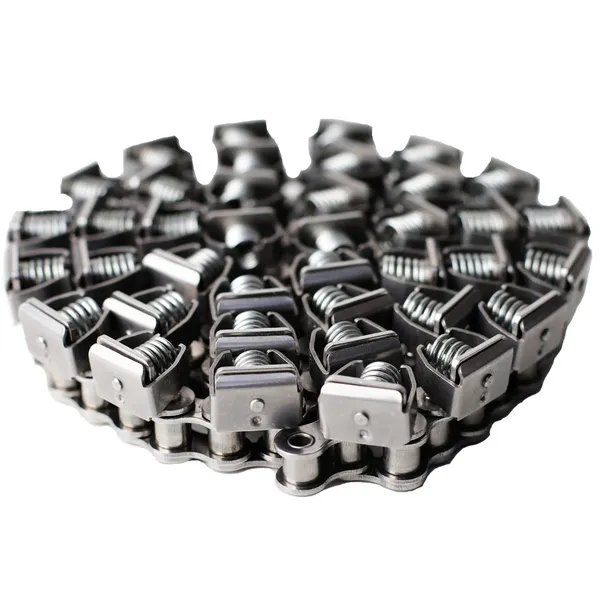
A conveyor chain is a type of mechanical chain specifically designed for use in conveyor systems. It is composed of a series of interconnected links that form a continuous chain loop. The links are typically made of metal and are joined together through pins or other connecting elements.
Conveyor chains work by transferring power and motion from the driving mechanism, such as a motor or sprocket, to the conveyor system to move materials or products along a predetermined path. The chain is placed on a track or guide rails, and as it moves, it carries the load placed on it.
The operation of a conveyor chain involves the following steps:
- Power transmission:
The driving mechanism transfers rotational power to the conveyor chain, typically through a motor and sprockets. The motor provides the necessary torque to drive the chain.
- Traction and motion:
As the driving mechanism rotates the sprockets, the teeth of the sprockets engage with the links of the conveyor chain. This interaction creates traction, causing the chain to move along the desired path.
- Load carrying:
The load to be transported is placed on the conveyor chain. The load can be in the form of products, materials, or other items. As the chain moves, it carries the load along the conveyor system, allowing for efficient transportation or handling.
- Support and guidance:
The conveyor chain is supported and guided by various components, such as guide rails, rollers, or wear strips. These components ensure the proper alignment and smooth movement of the chain along the conveyor system.
Conveyor chains are commonly used in industries such as manufacturing, logistics, packaging, and material handling. They offer a reliable and efficient method for moving products or materials in a controlled and automated manner.


editor by CX 2024-02-08