
Measure the machine interface before choosing the replacement
A replacement food conveyor chain or metal belt should be selected from the machine interface outward. Begin with the carrying geometry and drive method, then verify the guides, supports, transfers and return path that control how the component moves through the system. Model names and photographs are useful starting points, but they do not replace measured dimensions on a machine that may have been repaired or modified.
Record what the conveyor carries, how the product is spaced, the line speed, starts and stops, curves or inclines, process temperature, cleaning method and the location of any recurring wear. Separating geometry from operating duty makes the RFQ easier to review and reduces the chance of solving a guide or sprocket problem by changing the chain or belt specification.
Use the engineering guides below to structure the comparison. They are written for replacement, retrofit and OEM projects where the objective is to identify the interfaces that must remain fixed and the variables that can still be optimized.

Go directly to the engineering question that matches the project
Compare pitch, rollers, plates, attachments, sprocket engagement, guides and operating duty before approving a replacement chain.
Review mesh or wire geometry, edge construction, support path, drive method, tracking and transfer conditions for open metal belts.
Build inspection and cleaning around accessible joints, carry surfaces, guides, sprockets and return-path conditions rather than a generic interval.
Include the model when known, a dimensioned drawing or measured geometry, current machine photographs, duty conditions and quantity per line item. Send the complete technical package with the enquiry so dimensions and operating conditions can be reviewed together.
Keep geometry, operating duty and condition evidence separate
Measure pitch or mesh repetition, roller or rod diameters, inner and overall widths, carrying-surface dimensions, attachments and the mating drive and guide features. On a worn component, measure several repetitions and compare both unworn and worn areas where practical.
State the conveyed product, typical load or carrier size, speed, starts and stops, curves or inclines, heating or cooling zones, sanitation method and expected production quantity. These conditions determine which clearance and construction questions need additional review.
Record the location of polished edges, plate lift, joint stiffness, unusual elongation, damaged guides or sprockets, transfer steps and recurring noise before disassembly. Repeating symptoms at one machine position usually justify an interface inspection before a component change.
When these blocks are kept separate, the engineering review can distinguish dimensions fixed by the existing conveyor from choices that remain open. This is more reliable than treating a visual resemblance as interchangeability, especially on curved sushi conveyors, attachment chains and positively driven wire belts.
Inspect the whole path, not only the carrying surface
For chain systems, confirm sprocket engagement at the roller or chain body and check whether the carrying attachment clears the sprocket, rails and transfer structure. A crescent-top sushi chain also needs enough guide clearance to articulate through curves without allowing the plate to lift or rotate excessively.
For metal belts, identify whether the belt is friction driven, sprocket driven or chain driven. Record the support pattern under the belt, edge guides, drum or sprocket dimensions, take-up travel and the smallest transfer. An open belt can look mechanically simple while still being sensitive to support spacing and edge alignment.
Photograph the drive, a representative straight carrying section, the tightest curve or incline, each transfer and the return path. Include a ruler or known reference dimension when the geometry is difficult to describe in text.

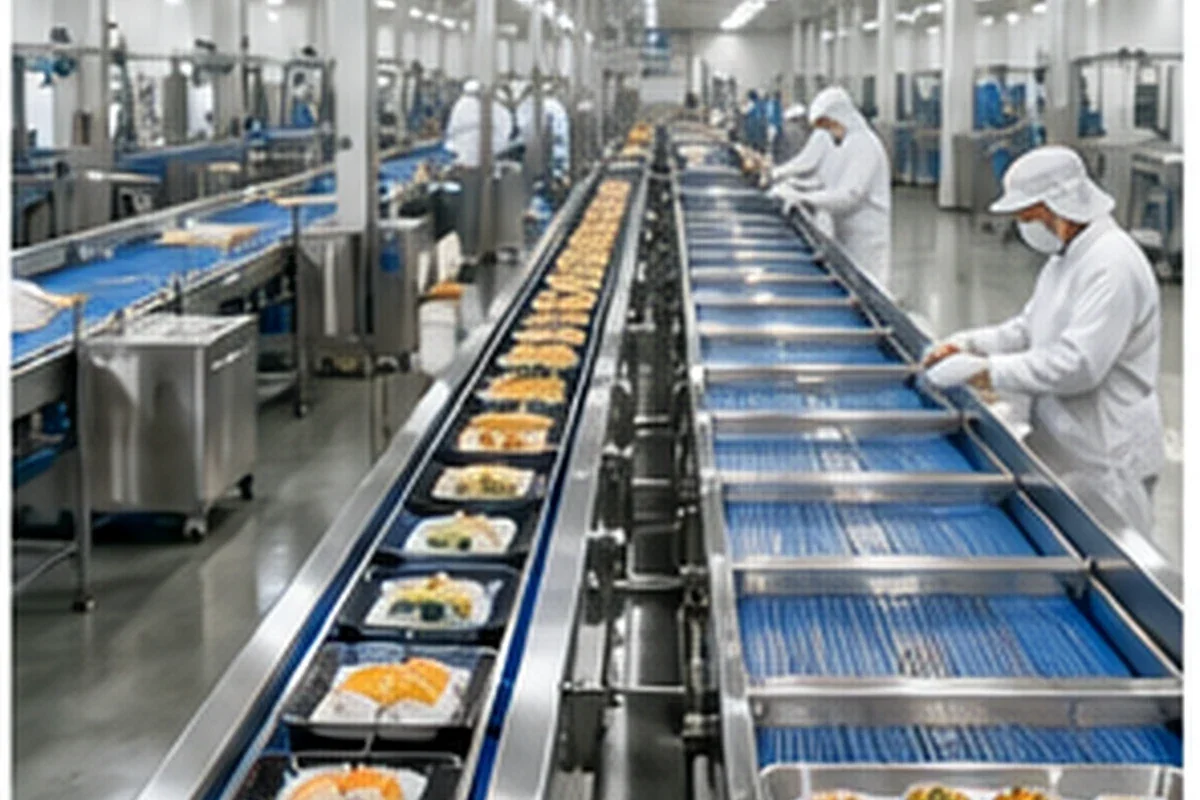
Confirm the complete path at low speed
Before normal production, clean the path and remove loose debris, then rotate or jog the conveyor through a complete revolution where the machine procedure allows it. Follow one marked chain joint, top plate or belt row through the drive, carrying run, transfers, curves or inclines and return path.
Look for a symptom that repeats at the same machine position: cyclic lift, edge rubbing, stiff articulation, guide contact, transfer impact, unusual noise or a local tracking shift. A repeatable position points toward a local guide, sprocket, support or transfer condition; a symptom that follows the component points toward the component itself.
Repeat the observation with representative product and record the accepted take-up, guide or tracking condition. That baseline gives maintenance a measurable reference instead of relying on memory after the next service interval.
Design maintenance around observable wear points
Food conveying equipment needs cleaning access, but the mechanical objective is not simply to wash the visible carrying surface. Inspect articulation points, pins, rollers, rods, hinges, guides, sprocket pockets, support strips and the return path. Residue trapped at a joint can restrict movement; a damaged guide can create metal-to-metal rubbing; a transfer edge can create recurring impact even when the chain or belt itself is dimensionally correct.
Use the machine maker’s sanitation procedure and compatible cleaning chemistry. After cleaning, verify that the conveyor is correctly reassembled, guards are restored and the component moves freely through the complete path. If corrosion, pitting, swollen guide material or persistent joint stiffness appears, document the location and cleaning conditions in the next technical review.
Send a concise technical package that can be checked
If an old component is badly worn, send measurements from several locations rather than one joint. For replacement projects, current machine photographs are particularly important because sprockets, guide rails or transfers may have changed since the conveyor was originally built.
Common questions before releasing a food conveyor component
Is matching pitch enough to approve a replacement chain?
No. Match the complete set of dimensions that control sprocket engagement, guide clearance and carrying geometry. Attachment, top-plate or overall-width differences can prevent a nominally similar chain from running correctly.
What is the most useful photograph for an unknown replacement?
Use several: a top and side view of the component, the drive sprocket, the tightest curve or incline, a transfer point and the return path. Include a known dimension for scale.
Should a conveyor be tested at production speed immediately?
No. Commission at low speed first according to the machine’s safe operating procedure, confirm free motion through the full path, then increase duty gradually while observing tracking, noise and transfer behavior.
How should wear observations be recorded?
Record both the component location and the machine location. This distinction helps determine whether the symptom travels with the chain or belt or repeats at a fixed guide, sprocket or transfer position.
What information prevents an incomplete RFQ?
Provide identification, measured geometry, machine-interface photographs, operating conditions and quantity. Add mandatory material or process requirements when they are genuinely required by the project.